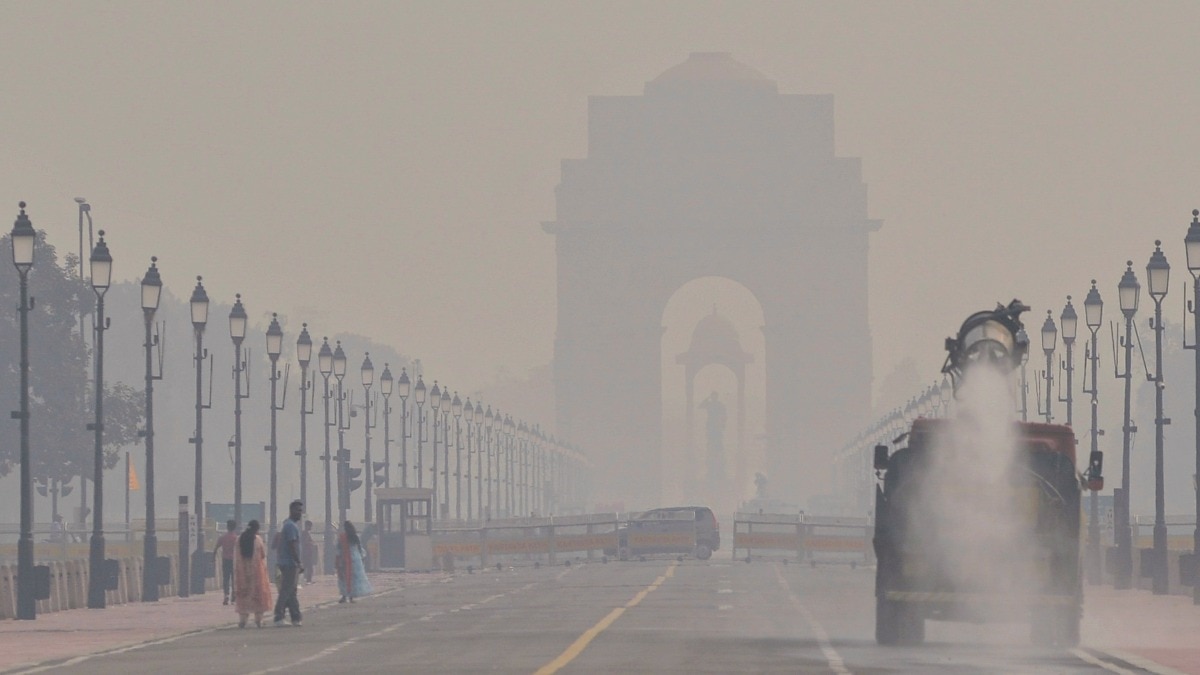
After Diwali, the air quality of Delhi-NCR remains in ‘very poor’ category. AQI has crossed 300 in many areas and a blanket of smog has surrounded the city. The concentration of PM2.5 reached 675 micrograms per cubic meter, which is the highest since 2021. At the same time, there is a thick blanket of smog in many areas of Mumbai.
According to CPCB data, the AQI on Diwali in 2024 was 330, 218 in 2023, 312 in 2022, and 382 in 2021. This time there was a sharp rise in pollution at night. The AQI was 344 at 10 pm on Monday night, which reached 349 by midnight and remained at 359 till 10 am the next morning. At 7 am on Wednesday, AQI was recorded at 361 in ITO, 355 in Anand Vihar, 318 in Alipore, 376 in Bawana, and 357 in Vivek Vihar.
AQI crosses 300 in Bandra
Apart from Delhi, pollution in Mumbai also remains in bad category. According to CPCB, there is a thick layer of smog in Bandra area of the city. According to CPCB, the air quality index (AQI) was recorded at 300 which is in the ‘poor’ category.
Pollution levels increase at night
According to CPCB’s hourly bulletin, AQI remained consistently high on Diwali night. AQI was 344 at 10 pm, 347 at 11 am, 349 at midnight and 348 at 1 am. The situation did not improve even on Tuesday morning. AQI remained stable at 346 at 5 am, 347 at 6 am, 351 at 7 am, 352 at 8 am, 356 at 9 am and 359 from 10 am to noon.
Dangerous level of PM2.5
PM2.5 levels were also the worst recorded in the last four years. It reached the highest level of 675 micrograms per cubic meter late on the night of Diwali. For comparison, PM2.5 was 609 in 2024, 570 in 2023, 534 in 2022, and 728 in 2021. The level of PM2.5 was 91 between 4 pm and 5 pm on Diwali, which reached 371 by 9 pm and 537 at 10 pm. These levels pose serious health risks to children, the elderly and people with respiratory diseases.
On Diwali, between 4 pm and 5 pm, the PM2.5 level was 91 micrograms per cubic metre, which increased every hour. It was 106 at 6 pm, 146 at 7 pm, 223 at 8 pm, 371 at 9 pm, 537 at 10 pm and reached 675 micrograms per cubic meter at midnight. On Tuesday this level again fell to 91 micrograms per cubic meter.
According to Central Pollution Control Board (CPCB) data, Delhi’s 24-hour average air quality index (AQI) stood at 345 in the ‘very poor’ category at 4 pm on Monday.
Supreme Court ignore orders
The Supreme Court had given permission to burn green crackers from 8 to 10 pm on Diwali, but people celebrated till late night. Due to which the 24-hour average AQI of Delhi at 4 pm on Tuesday was 351 in the ‘very poor’ category.
Role of neighboring states
According to Decision Support System (DSS) data, on Tuesday, air pollution The contribution of emissions from transport was 14.6%. The contribution of neighboring states in this was as follows: Ghaziabad 6%, Noida 8.3%, Gurugram 3.6% and the contribution of stubble burning was 1%.
GRAP-II restrictions implemented
According to satellite data on the day of Diwali, 45 incidents of stubble burning were recorded in Punjab, 13 in Haryana and 77 in Uttar Pradesh. CAQM on Sunday implemented Phase II of the Graded Response Action Plan (GRAP) in Delhi-NCR.
According to CPCB, AQI 0-50 is considered ‘good’, 51-100 ‘satisfactory’, 101-200 ‘moderate’, 201-300 ‘poor’, 301-400 ‘very poor’ and 401-500 ‘severe’.
—- End —-
