
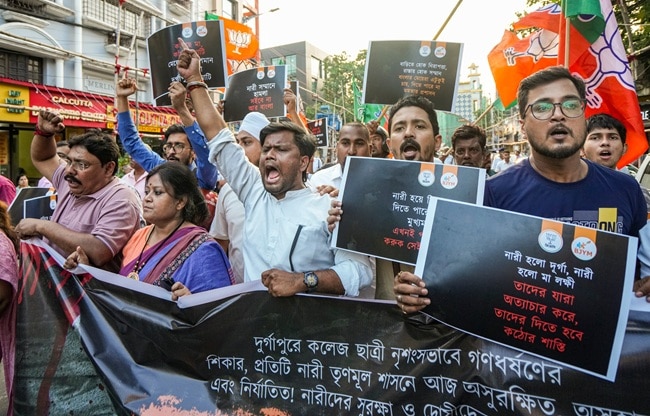
After the rape and murder of a female doctor in Kolkata’s RG Kar Hospital, the case had not cooled down when many such cases started coming up. Some time ago this happened with a law college student. Now the incident of gang rape of a medical student in Durgapur and CM Mamata Banerjee’s statement on it has created a political storm. Meanwhile, the need for Renaissance 2.0 is being felt in West Bengal.
What is the matter that created a storm?
The investigation into the gangrape of a private medical college student in Durgapur of Bardhaman district is going on. Meanwhile, CM Banerjee said that the student was out late at night. Girls should avoid this and be cautious while going to deserted areas. Such superficial statement on a very sensitive issue has created an uproar. Meanwhile the Governor CV Anand Bose Met the victim and her family. During this, he said that another renaissance is necessary to make Bengal safe for women.
But what was the first Renaissance?
The Bengal Renaissance took place in the late 18th and early 19th centuries. This was the period when major changes took place in Bengal, be it art-culture or social practices. In true sense, after this Bengal emerged as the representative of the entire country.
Bengal started changing at the end of the 18th century. Earlier it was only the center of agriculture and trade, but gradually a new wind started blowing in the cities. The British were present in Kolkata. They had come from across the seven seas and many new things were visible in their culture. This created a stir in people’s thinking. People were no longer limited to just religion and tradition, they wanted to see and understand the world.

It started with education. New types of schools and colleges opened. English language and Western methods started being taught. Big emphasis on western science. During this period, there were also social reformers like Raja Rammohan Roy, who abolished the practice of Sati and child marriage.
Bengal was already rich in art and culture but now fusion of modernity started taking place in it. Meanwhile, trade from the sea coasts of Bengal was also flourishing. Overall, this renaissance was not limited to literature or culture only, but it had a long and far reaching impact.
Bengal played a big role in spreading new education, English and science throughout the country. Kolkata and its surrounding areas started becoming a hub of thinkers and scholars. New experiments started taking place in every area, the center of which was Bengal.
There has been a huge change
This was Bengal before independence, which was a big province under British rule. It was also called the Bengal Presidency, which included today’s west bengal And East Bengal (now Bangladesh) was also included. Apart from Bihar, some parts of Orissa and Assam were also included in it. At that time this province was very strong economically. Great Indian thinkers did everything possible and sounded the trumpet of renaissance. After this it also became an intellectual centre.
Who used the word renaissance
British historian John Stratton was present in Bengal then. They were seeing that the people there were not only adopting western ways, their way of thinking was also changing. Questions are being raised on old things. New schools and colleges are opening. Women are getting a better life. These were not minor, but big changes. Then he used the term renaissance for this. Later this word became the symbol of change and modernity. Local Bengalis started calling it Bengal Renaissance.
Even after this, changes continued to take place in many parts of the country, but none were as big and far spreading as Bengal, rather remained limited to that place. That is why even today that period of Bengal is remembered as one of intellectual and cultural change.
Why was there a need for change?
Let us return here to the statement of Governor Bose, in which it was said that there is a need for renaissance in the state for the safety of women. In fact, before that the condition of women there was quite bad. The practice of Sati and child marriage were common. Due to malnutrition, girls used to die at an early age. Women had very limited rights to land, property or education. She was never made a part of any major decision. Life was especially difficult for widows.
The pressure inside the ground was slowly increasing and then there was an explosion of change. The presence of English acted as a catalyst and a period of awakening began. However, it is also true that the British interfered in local customs only to a limited extent. He believed that only keeping distance from local traditions would allow him to rule for a long time.
—- End —-
