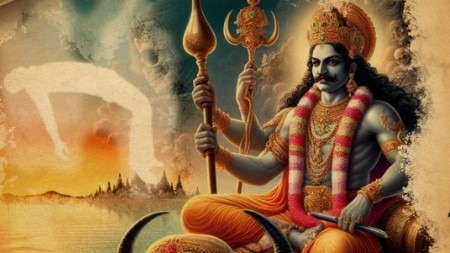
In the Indian Sanatani tradition, death is considered an aspect of life, hence it is not considered negative anywhere in the Vedas and Puranas. This is the reason that while in other traditions Death is a Devil and Satan is his companion, in the Sanatan tradition the God of Death is Yama, who is the one who gives the dead souls their next world.
His appearance is terrifying, yet he is not a symbol of fear but of religion. That is why Yamraj has been called Dharmaraj, because he is very firm in following the religion and the Vedas have conceptualized him as the protector of religion. This is the reason why Yama sometimes appears in the form of Harishchandra as a part of religion, whereas in Mahabharata he becomes the actual religion and is born in the form of Vidur and Yudhishthir.
Yamraj is known as Vivasvan Yama in Rigveda.
In Rig Veda, Yama has been called Vivasvan Yama. Probably for this reason Yama has been called the son of Surya in the Puranas. Vivasvan is a name of the Sun in the Vedas. The 14th sukta of the tenth division of Rigveda is Yamsukta. In this, while praising Yama, it is said that, Vivasvan Yama, you are the one who will take out the dead souls from the cremation ground and give them the best world. Therefore you come and accept this offering of Yagya. You maintain peace in this world and maintain the laws of nature.
Pareyivansam pravto mahiranu bahubhyah panthamanupaspashanam.
Vaivaswatam Sangamanam Jananam Yamam Rajanam Havisha Duvasya ॥1॥
Yamo no gatun prathamo viveda naisha gavyutirapabhartava u.
Yatra Nah Purve Pitrah Pareyurena Jajnaah Pathya Anu Swah ॥2॥
Matali kavyairyamo angirobhirbhrispatirrikvabhirvavridhanah.
Meaning: Offer oblations to Yama, the son of Vivasvan, who takes the people who perform virtuous deeds to the right place after death and gives them auspicious places according to their deeds. Offer Yajnabhag to him. Everyone has to go to him. He is the only one who has the knowledge of sin and virtue and is the one who knows religion. No one can change the path of Yama, the path on which our ancestors have already gone, we all will go on the same path according to our karma.
Many characters of Yama in mythology
The trend of calling Yama a religion also happened because Yama never wavers in his duty. When the time cycle of life is completed, Yama takes away the lives of everyone without any discrimination. This is the reason why in the Puranas, kings like Shiva, Yudhishthir, Vidur and Harishchandra are considered the incarnation of religion. This religion is none other than another name of Yamraj.
eldest son of sun god
Regarding the birth of Yama, there is a story in Bhagwat Purana that he is the son of Sun God. Suryadev was married to Vishwakarma’s daughter Sandhya, but Sandhya could not bear the brightness of the Sun and started staying away from him. After the birth of Surya’s twin children Yama and Yami, she manifested a shadow of herself and herself went to live in her father’s house. In this way Surya had four children. Yama and Yami from Sandhya, Shani and Tapti from Chhaya.
Yama is the guru of Nachiketa in Kathopanishad.
In the Vedas and Upanishads, Yama has been described as the symbol of truth and religion and has also been called the most knowledgeable person. Yama is the one who understands and explains the real value of life. This is also confirmed by the story of Kathopanishad, in which Yama had given the knowledge of deep secrets of life to the child Nachiketa.
The story goes that Nachiketa’s father Vajashrava performed a big yajna and pledged to donate all his cows. In fact these cows were sick and old. Nachiketa did not like this. He started stopping his father from donating and said that he donates only his favorite and best things. I am the most dear to you, so tell me to whom you will donate me. Vajashrava became angry when Nachiketa repeatedly asked such questions and he angrily said, “Go, I will donate you to Yama.”
Nachiketa traveled to Yamalok to keep his father’s words. After reaching there, he pleased Yamraj and obtained knowledge of the basic essence of life from him. In this story, Yama’s fierce form has been described, but he has also been described as having a calm mind and being knowledgeable and knowledgeable in mysticism. This story of Nachiketa written in Kathopanishad is the first attempt to solve the confusions found in humans regarding the curiosities of life.
Yama is also mentioned in the story of Savitri and Satyavan, where Savitri succeeds in taking away the life of her husband Satyavan from Yama and Yama also grants her the blessing of kingdom and son along with unbroken good fortune.
Chitragupta is Yama’s ally
Chitragupta is his ally in following the Dharma with which Yama does his work. Chitragupta is not like any devil or devil, rather he is calm, gentle and an expert in many types of arts. They have Yaksha qualities. He is adept at calculations and capable of maintaining accounts. Therefore, Chitragupta is shown as a religious symbol along with Yamraj, the embodiment of religion.
Diwali On one hand, the fifth day of Yam Dwitiya symbolizes the worship of Yamraj in the form of Yamdwitiya, while on the other hand, Chitragupta Puja is also celebrated today, the influence of which is mainly visible in Bengal-Bihar and Eastern Uttar Pradesh. Chitragupta Puja is celebrated in the Munim and Munshi community of Rajasthan also and they consider themselves descendants of Chitragupta.
—- End —-
