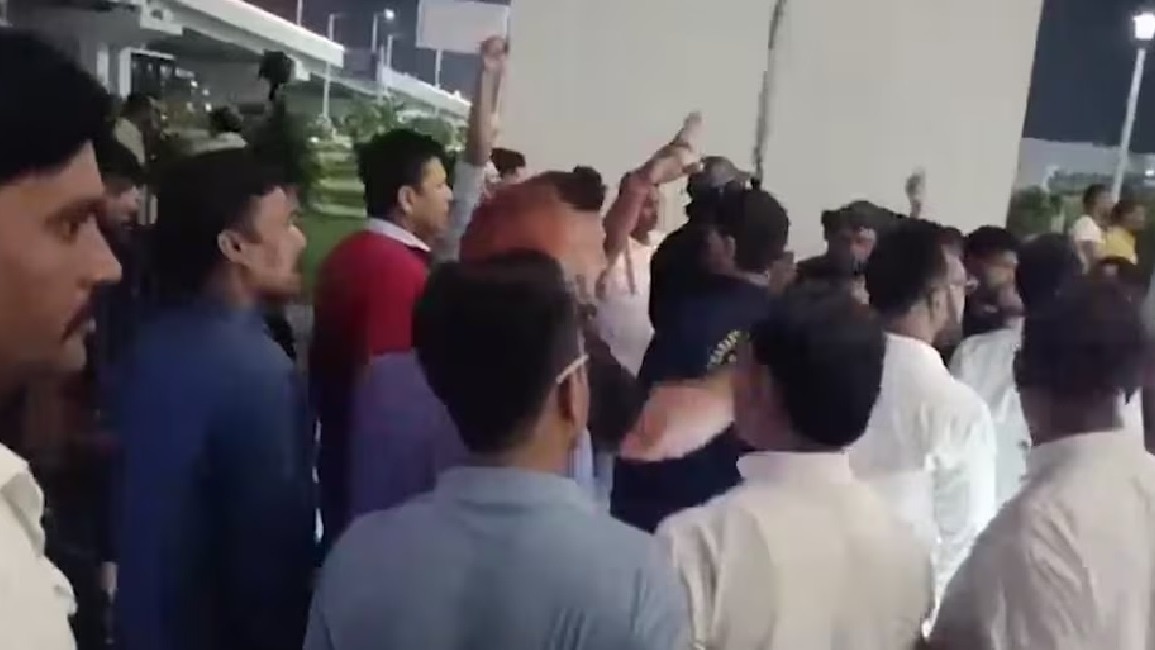
The video of Congress workers protesting against state in-charge Krishna Allavaru, state president Rajesh Ram and legislature party leader Shakeel Ahmed Khan at Patna airport and beating up a youth leader is going viral on social media. It was said that this was a direct result of the anger of the workers over the deadlock over seat-distribution in the Grand Alliance (INDIA Bloc) on the threshold of Bihar Assembly elections. It cannot be denied that all this might have happened due to factionalism in the party. But the question arises that why did such a situation arise? Obviously, if such incidents happen, questions will definitely be raised about the leadership’s hold on the party.
1-Lax attitude of central leadership and lack of coordination
Bihar Assembly Election 2025 The biggest crisis of the Congress just before the elections is not organizational weakness, but strategic delay and lack of coordination. This is the same mistake that the party has been repeating again and again for the last decade and every time the state units have to bear the political loss.
The main reason for the confusion that remained within the Grand Alliance (INDIA Bloc) regarding seat sharing in Bihar was that Congress The central leadership of the organization, especially Rahul Gandhi, Mallikarjun Kharge and organization general secretary K.C. Venugopal etc. could not take decisions on time.
The state unit kept waiting for clear instructions from Delhi, but the agreement on the names of candidates and the number of seats was reached at the last minute. The result was that neither the Congress remained in a strong position in front of its alliance partners, nor was it able to instill confidence among its workers.
According to sources, state president Rajesh Ram and in-charge Krishna Allavaru had informed the high command about the ground situation in Bihar since August. He had clearly said that the party should be prepared to contest on at least 65 seats, so that the pressure from RJD can be countered. But the central leadership did not take any concrete decision on this suggestion.
There was no clear roadmap on ticket distribution and promotion strategy till the last week of September. By the time the talks progressed at the top level, RJD not only fixed the seat distribution in its favor but also spread the message among the public that Congress is now only in the role of an ally. And this was confirmed by Rahul Gandhi’s foreign trip. On the occasion of Bihar elections, Rahul Gandhi, the question arises that the Congress party which disappeared from the main scene for 2 weeks a few days ago. Obviously, this sent a clear message that Congress now wants to remain as a stooge of RJD.
The lack of coordination is clearly visible not only with RJD but also within the party. There were continuous differences between Bihar Pradesh Congress Committee, Election Committee and Central Screening Committee. On many seats, names of two candidates each were sent to Delhi, raising questions about the seriousness of the organization.
Political observers believe that this complicated decision-making process of Congress has become the biggest weakness of the party. When the leadership does not take decisions on time, the workers become disappointed and start taking the alliance partner party lightly. Due to its internal delay and lack of mutual coordination, Congress not only lost its old seats in the Grand Alliance, but has also lost its claim of equal participation.
It is clear that if the Congress high command had adopted a clear and decisive strategy in time, it would not have faced a crisis of respect in Bihar today.
2-Lack of communication and internal factionalism of the state leadership
The second major reason for the current situation of Bihar Congress is the lack of communication and factionalism of the state leadership. This problem is not new, but is part of a long-standing tradition in which party leaders give priority to their personal politics rather than that of the organization. This trend has deepened just before the assembly elections 2025, which not only spread dissatisfaction among the workers but also weakened the credibility of Congress in the alliance.
The lack of coordination between state president Rajesh Ram, in-charge Krishna Allavaru, and legislative party leader Shakeel Ahmed Khan has come to the fore. There are clear differences in the working style and political outlook of the three leaders.
On the other hand, Krishna Allavaru is considered to be the representative of Delhi Darbar, who is accused of not maintaining communication with local leaders and adopting a unilateral approach in ticket distribution. This lack of communication was visible at every level of election preparation. In many districts there was no coordination between the District Congress Committee and the State Committee. Opinion of local leaders was not taken before candidate selection, due to which resentment spread among the workers. This was the reason why party workers raised slogans against their own state in-charge and president at Patna Airport. This was not just dissatisfaction, but a sign of loss of trust in the leadership.
3- Tough bargaining on seat-sharing in the Grand Alliance
Due to disagreement between Congress and Rashtriya Janata Dal (RJD) on the number of seats and fielding their candidates on certain constituencies, a squabble is still going on in the Grand Alliance on the second last day of the first phase of nominations. In the 2020 elections, Congress won 19 by contesting 70 seats, while RJD won 75 by contesting 144. Now Congress wants the same 70 seats, but RJD does not want to reduce its share. Whereas space also has to be made for new players in the alliance.
This dispute broke out in meetings held in Delhi (e.g. between KC Venugopal and Tejashwi), leading to strained relations. After this, RJD and Congress also attacked each other through poetry on social media. When MP Manoj Jha hinted at a couplet on the tweet (Toote man ka manuja mitte na gathri), Congress’s Imran Pratapgarhi also responded with a couplet in the same style.
On the other hand, the role of other colleagues is also not good. There are also different claims among parties like CPI-ML, CPI, CPM, JMM and VIP (Mukesh Sahni). Mukesh Sahni’s issue was resolved recently, but left parties are not ready to give up their traditional seats.
4. RJD’s aggressive deal-politics, which pushed Congress to the margins.
During the preparations for Bihar Assembly elections 2025, seat distribution in the Grand Alliance (INDIA Bloc) was the biggest deciding factor. Aggressive deal-politics of RJD (Rashtriya Janata Dal). Tejashwi Yadav This time, under the leadership of RJD, the strategic way in which seat sharing politics was done clearly pushed Congress to the margins.
Tejashwi Yadav, now completely at the center of party decisions, established coalition politics as one of leadership primacy rather than equal partnership. He believes that RJD controls the biggest vote-bank in Bihar politics. Especially the Yadav-Muslim equation is within his grasp. Therefore, they should get priority in seat distribution. This is the reason why while Congress had got 70 seats in 2020, efforts are being made to limit it to only 58 seats in 2025.
This strategy of RJD was not limited to mere seat distribution. The party presented itself as the main face in candidate selection, campaigning, and even narrative-setting of the alliance. For example, Tejashwi consistently presented himself as the chief ministerial candidate of the Grand Alliance in election rallies. Whereas Congress has never openly accepted Tejashwi as the Chief Minister candidate till now. Tejashwi made many promises to the people of Bihar but Congress is not included in those promises anywhere.
Congress, which was already organizationally weak, found itself on the defensive in the face of this aggressive deal-politics. Its leaders did not have bargaining power because neither their vote-bank is strong nor can they change the electoral equation on their own.
—- End —-
