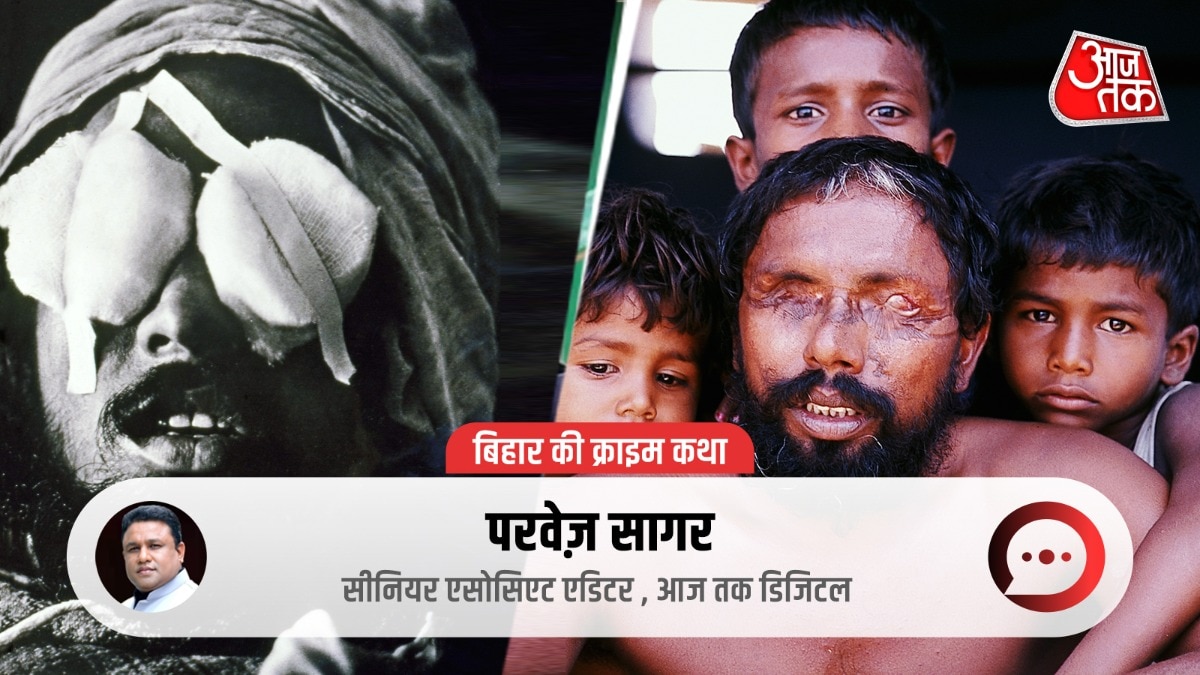
An atrocity took place in Bhagalpur district of Bihar around 1979 and 1980, which is still mentioned in the politics there. That was the ‘Ankhfodwa incident’ of Bhagalpur. During this incident, under the guise of controlling the crime, the policemen had blinded 33 under-trial prisoners by pouring acid in their eyes. This incident was not just an act of the police, but a terrible violation of human rights. Which not only devastated the affected families, but also left a deep stain on the entire justice system and the image of Bihar. A stain that could never be erased. His memories still leave people stunned. ‘Bihar Ki Crime Katha’ presents the sequential story of the heart-wrenching eye-popping incident of Bhagalpur.
The fabric of crime in Bhagalpur
In the 1970-80s Bihar The problem of crime, social tension and insecurity was deep. Land disputes, caste conflicts and criminal groups were active in rural areas. Bhagalpur was also a sensitive district of Bihar, where complaints of crime were common. The situation was such that the police were under pressure to control crime. Many reports of that time show that the local administration had difficulty in taking prompt action. At that time the concept of arrest and punishment before conviction was prevalent. But the legal process, judicial review and human rights protections were very weak. In this background, the excessive police action was shown as a court action. This background created an environment in which speedy justice was given priority over justice.
Beginning of Operation Aankhfodwa incident
According to some documents, in October 1979 Bhagalpur The police launched a covert operation in which under-trial prisoners were rounded up. The police brought those prisoners to different police stations. No one had any idea what was going to happen to them. The atmosphere of those police stations was very tight. After this, suddenly the policemen entered the lockup and one by one they threw the under-trial prisoners on the ground and caught hold of their hands and legs. Then they pierced his eyes with a thin iron sharp weapon like a needle or a spindle. The screams of the prisoners were echoing in the police station. But there was no one to listen. The story of crime did not stop here. After this, acid was poured into his pierced eyes. They continued to suffer. Kept screaming. But the policemen had no mercy. Such cruelty was done to those prisoners that the souls of those who heard and saw shuddered.
According to media reports, some witnesses who became victims of this brutality later gave statements that during the process, the policemen used to ask, are you able to see anything? The victim would say that nothing was visible, then similar action would be taken against the next prisoner. This sequence continued continuously from October 1979 to July 1980. There was an atmosphere of panic due to this action of the police. Even the criminals were scared.
circumstances of the victims
Most of the people who were blinded during the Bhagalpur Ankhfodwa incident were poor, Dalits or from lower castes. It is said that his social conditions kept him away from justice. Due to his backward background and deprived class, he did not have legal resources or lawyers. Nor any pressure groups that can give them a voice. Thus, he was thrown into the abyss of an unheard of tragedy. Some names like Umesh Mandal, Bhola Chaudhary, Kamla Tanti etc. have always been telling a painful story in this matter.
The interesting thing in this case is that in the name of crime control, the police committed such atrocities that the basic principle of justice i.e. protection of innocents was forcefully postponed. This was done only because the victims did not have resources.
This is how the eye-popping incident was revealed
Such a big scandal kept happening but no one was even aware of it. No one knew anything about this heart-wrenching incident for a long time. Because this matter was kept suppressed in a very clever manner. But Jail Superintendent of Bhagalpur Jail, Bachchu Lal Das and advocate Ramkumar Mishra exposed this hidden atrocity and exposed it to the world. By the time this matter came to the media, the police had destroyed many evidences and documents. Witnesses were threatened and attempts were made to hide the culprits. At that time, the Congress government of Bihar and the local administration had tried to find a peaceful solution to this incident. Action was taken to suspend the accused police personnel, but later a move was made to quietly reinstate them.
Discussion at national and international level
The matter became public in November 1980, when Jail Superintendent Bachchu Lal Das and advocate Ramkumar Mishra exposed this matter and sent its report to the higher authorities. This incident was so horrifying that the country’s biggest court i.e. the Supreme Court took suo motu cognizance of this matter and ordered an investigation. This was the first time that the highest court in India had intervened on human rights violations. The incident was strongly condemned by the national media, opposition parties and international human rights organizations. There was a fierce debate on this matter in the Rajya Sabha on 2 December 1980, and the government had to respond to this action.
Historic decision of Supreme Court
The Supreme Court made it clear in this case that this action is a violation of the fundamental rights of the Constitution i.e. life and personal liberty. The court had ordered lump sum compensation and release of lifelong pension to each victim. Additionally, instructions were given to ensure suspension of guilty policemen and the process of judicial inquiry. This was the first case when the Indian justice system had to recognize the system of compensation and pension for human rights violations.
Untimely reinstatement of culprits
Despite the strong warning from the Supreme Court, the state government gradually reinstated many suspended police and administration officials. No concrete action was taken on the role of higher officials. However, the then Bhagalpur SP Vishnu Dayal Ram was considered an accused. Thus, most punishments remained limited to low-level officials. Many culprits were saved from trial. This imbalance greatly reduced trust in justice among victims and the public.
Compensation, pension and suffering
The Supreme Court had ordered that a fixed deposit of Rs 30,000 should be given to each victim and pension with interest should be released from the bank. Initially this pension was given at Rs 500 per month, later it was increased to Rs 750. But with time long-term problems started emerging. Irregularities in pension distribution, bank documentary problems and administrative negligence started appearing. By 2020, at least 15 victims had died. The pensions of about 18 remaining victims were stopped or distribution was delayed. Describing this situation the victim says, ‘We are blind, we can neither walk nor see. Pension was our hope for survival.
Film, Media and Creepy Memories
The story of this horrifying eye-popping incident of Bhagalpur made its own place in literature, film and journalism. Ajay Devgan’s famous film ‘Gangajal (2003)’ was inspired by this true incident. The documentary ‘The Eyes of Darkness’ showed this incident and revealed that other such incidents had been inspired by this incident. This scandal repeatedly highlights the limitations of police brutality, justice administration and human rights protection in the media and social discourse. It is often cited as an example in human rights courses, journalism discussions, and the study of jurisprudence.
legal and ethical lessons
Bhagalpur’s eye-popping incident showed that no one is above the law. The state will also have to respect the rights of its citizens. He also made it clear that the meaning of Justice Delayed can be very bad. If action is not taken on time, inhuman torture may occur on prisoners. Another lesson is that lower castes and deprived sections do not have access to the justice system. Therefore, a law that is not linked to social justice is incomplete. This scandal also showed that the Court should play a proactive role and the Supreme Court taking suo motu cognizance in cases of human rights violations became an important milestone.
Current Situation and Challenges
By the year 2022–23, most of the victims have died, and the survivors are living in poverty, disease and social neglect. His pension has been withheld for several months, in this case the authorities give the excuse of lack of documents and legal complications. Many families have said that justice is given to those who shout loudly or can reach the Supreme Court. But they can’t do that. It is not possible to forget this incident.
Arun Shourie had revealed
Senior journalist Arun Shourie has expressed the pain of that dreadful incident in his book ‘The Commissioner for Lost Causes’. Shourie writes that humanity was trampled on in police custody to such an extent that even the eyes of the prisoners were gouged out. The police would first bring the undertrial prisoners to the police station, then throw them on the ground. Some soldiers would hold their hands and legs tightly and a policeman would poke a hole in their eyes with a sack-like stitch or thread. After this, the so-called doctor would come, who would pour acid and ensure that they could not see anything for the rest of their lives. And the irony is that the policemen used to call that acid as ‘Gangajal’.
heartbreaking truth
Shourie tells that once the eyes of seven prisoners in the jail were gouged out in this manner. When a doctor asked if anyone could still see, two prisoners said hopefully, ‘A little bit.’ But this hope also became his punishment. He was taken outside again and blinded with acid. Later, when the reports of BBC and ‘Indian Express’ came out, the country was shocked. A total of 33 prisoners were blinded. When pictures of prisoners with their eyes wrapped in bandages and sobbing prisoners were published in the newspapers, the soul of the country shuddered. But the Bihar government tried hard to suppress it, while the Supreme Court took suo motu cognizance and said that such criminals should be punished in such a way that no one can even think of doing this again. Still the wheel of justice moved slowly.
Incomplete justice, fight continues
The Bhagalpur eye-popping incident is a stinging reminder of how police brutality, divisiveness, lack of justice and social deprivation can combine to ruin the lives of innocent people. This is a warning of the weakness of our justice system that the law can be suppressed by force. This case is important in history because it forced the Supreme Court to take proactive action on human rights violations and provided legal recognition and compensation to the victims. However, the fight for justice is still incomplete. Because even after years, the remaining victims are yet to get their rights.
—- End —-
