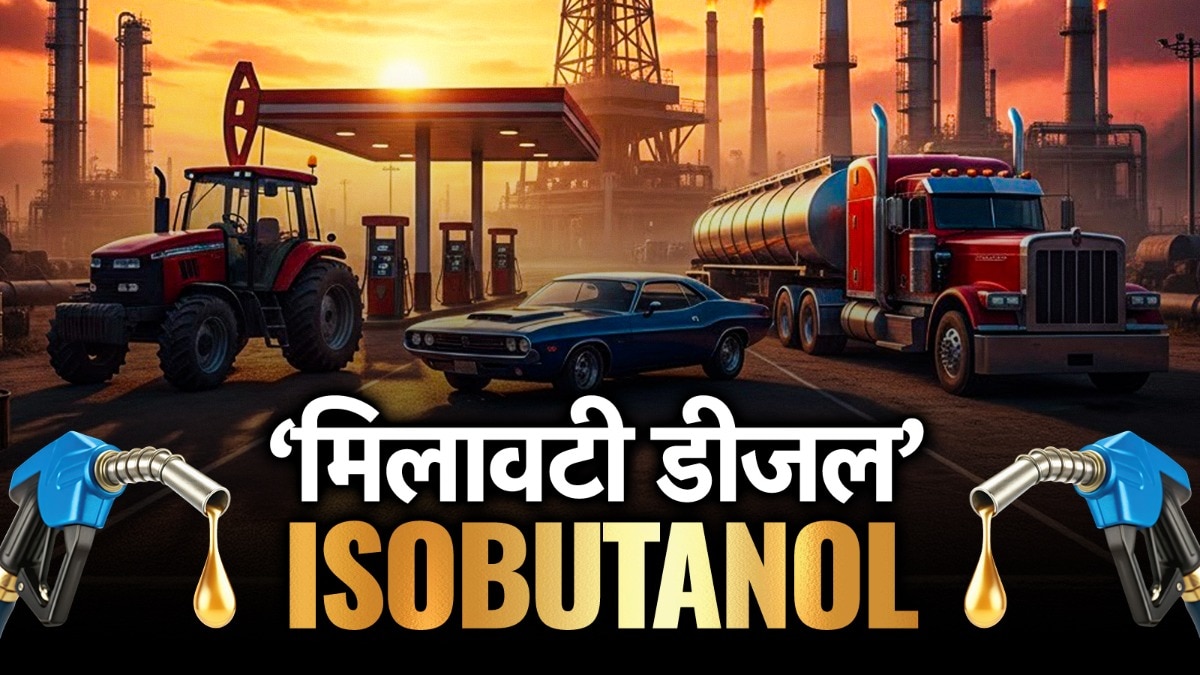
Isobutanol Blending In Diesel: There is an uproar over Ethanol Blend Petrol (E20 Fuel) across the country. Every day, vehicle owners are complaining that after the use of E20 petrol, the mileage of their vehicles has been affected and the maintenance cost has also increased. Recently a survey report has also come out in this matter, in which 8 out of 10 people have accepted the adverse effects on vehicles due to E20 fuel. Now the government is preparing to adulterate diesel after petrol. Which will not only affect diesel-powered cars, tractors, trucks and buses, but will also affect major machinery in the country.
What is the government’s plan?
A few days ago, at an event organized by Praj Industries in Pune, Union Road Transport and Highways Minister Nitin Gadkari said, “ethanol For us this is a beginning, this is not an end. Praj Industries and ARAI have started working on isobutanol after ethanol. Right now they are experimenting by adding 10% isobutanol to diesel. Apart from this, in collaboration with Kirloskar, he has also developed an engine running on 100% isobutanol.”
Nitin Gadkari said, “Isobutanol can become an excellent alternative to diesel. In our country, diesel is used two and a half to three times more than petrol. After research, trials and standards are finalized, when its proposal will go to the Petroleum Ministry and it will be approved by the Ministry, then its market will increase further.”
That is, after mixing 20 percent ethanol in petrol, the government is preparing to mix isobutanol in diesel. This adulteration will have a huge impact not only on vehicles but also on the industries in the country whose machinery uses diesel.
What is isobutanol?
At present, research is being done on blending of isobutanol in diesel and it is in its initial stages. But before this it is important to understand what is isobutanol. Isobutanol (C₄H₁₀O), which is a colorless and odorless substance, is basically a colorless, flammable organic liquid from the alkanol (alcohol) group. It can be used as a blender in diesel. As at present ethanol is used in petrol. It is a renewable fuel which is made from biomass or sugar based feedstock.
Most of the research on blending of isobutanol in diesel indicates that it is beneficial from the environment point of view, but it has more disadvantages for the engine. This can prove to be especially harmful for old diesel engines. So let us understand how this new experiment will affect vehicles and machinery.
cetane number
Understand the cetane number before proceeding. Cetane Number is an important parameter indicating the combustion quality of diesel. It tells how quickly and easily the fuel starts burning in a diesel engine. In simple words, the higher the cetane number, the easier and smoother the diesel burns, resulting in less engine noise, vibration and smoke. Generally the cetane number of diesel is between 45 to 55. If this number is too low then problems like knocking and delayed starting may occur in the engine. Whereas higher cetane number leads to better performance, lower emissions and better mileage.
Low cetane number in isobutanol
The cetane number of isobutanol is very low i.e. between about 10–15. From this it is clear that the engine may have problems like delayed starting or low-performance. Apart from this, reports also suggest that the power and torque of the engine may also decrease by 3 to 5 percent.
Effect on engine performance
- Adding isobutanol in light blending (e.g. 10–20%) can increase engine smoothness.
- Its calorific value is less than diesel, hence a slight drop in mileage and power output may be seen.
- Excessive blending (50% or more) may affect the engine’s fuel injection system and seals. Because the chemical nature of isobutanol is different from diesel.
Effect on engine lines and lubrication
The lubrication property of isobutanol is less than that of diesel. Due to which its use for a long time can increase the risk of wear and tear on the injectors, pumps and valves of the vehicle. Therefore, it is better to mix it only in limited proportions (usually 10–20% blending is considered better). Its use for a long time can also affect the life of the engine.
Overheat…a big problem
Blending of isobutanol in diesel will also affect the maintenance of vehicles. Be it car, tractor, truck or bus. It has high oxygen content (about 11%), due to which more heat is generated during combustion. Due to this, the engine of old vehicles can overheat in a short time. Apart from this, the possibility of damage to the valves/pistons of the vehicles cannot be ruled out.
Impact on tractors and trucks
According to media reports, at present there are about 1 crore trucks, about 18 lakh registered buses in the country and about 40% of the farmers in the country have tractors. Most of these vehicles are old, even some farmers have been using the same tractor for the last two generations. In such a situation, blending of isobutanol with diesel can prove to be very harmful for them. Because the engines of these old tractors and trucks have not been designed according to the new modern fuel.
However, research is still going on regarding mixing isobutanol in diesel. As Nitin Gadkari also told that the agencies related to it are experimenting on it. This means that it will take some time for the final report on this diesel blending to come. There is no information available yet as to when the government will start using it in diesel. Currently, this project is in the initial stage and after success in research/experimentation, its proposal will be sent to the concerned ministry, from where it will get final approval.
—- End —-
