Meta Title: WPM Test Explained: What’s a Good Typing Speed in 2026? | CPS Testers Meta Description: Learn how WPM is calculated, what counts as a good typing speed in 2026, and how to boost your score with our free WPM Test. Slug: /wpm-test-explained-good-typing-speed-2026/
If you’ve ever raced through a paragraph on a typing test and wondered whether your score is actually good, you’re not alone. “WPM” — words per minute — is the single most common way the internet measures typing skill, yet most people have no real benchmark for what a strong result looks like in 2026. Is 40 WPM slow? Is 80 WPM elite? Does it matter if you’re a student, a programmer, or a customer support agent?
This guide breaks down exactly what WPM means, how it’s calculated, what counts as a competitive score this year, and the fastest ways to improve — with real benchmarks you can compare yourself against using our free WPM Test.
What Does WPM Actually Mean?
WPM stands for Words Per Minute — the number of words a person can accurately type in one minute. It’s the typing equivalent of a speedometer: a single number that reflects both your raw finger speed and your ability to sustain that speed over time.
But there’s a catch most people don’t realize: WPM isn’t measured by counting how many “real” words you type. Words vary wildly in length (“a” versus “extraordinarily”), so a fair test needs a standardized unit.
How Is WPM Calculated?
Almost every typing test online — including ours — uses the same industry-standard formula, borrowed from the world of stenography and typewriting championships:
WPM = (Total Characters Typed ÷ 5) ÷ Time Taken (in minutes)
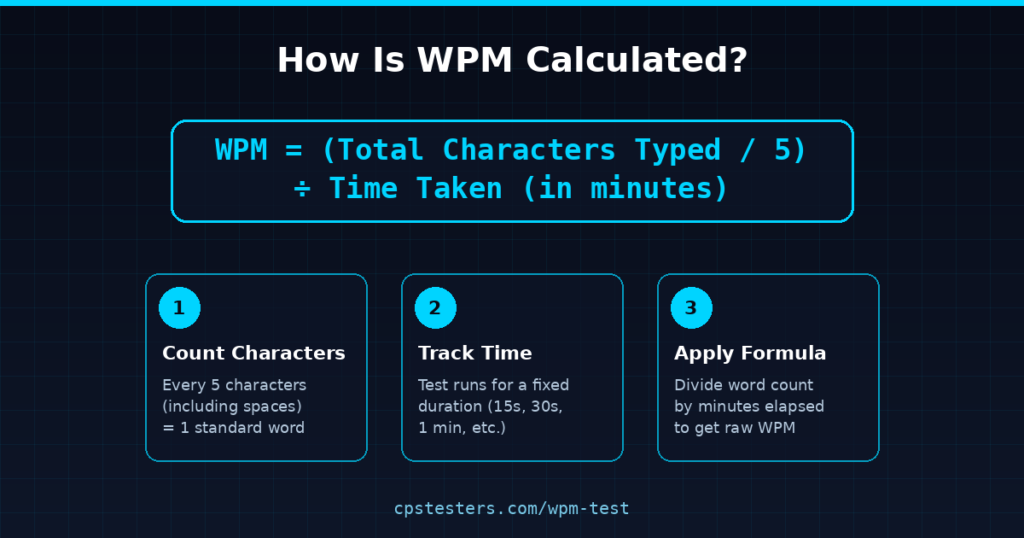
Here’s why the “divide by 5” step matters: typing tests treat every 5 characters (including spaces) as one “standard word.” This removes the unfairness of counting actual dictionary words, since “cat” and “cataclysmic” would otherwise be scored identically as “one word” despite requiring very different amounts of typing.
So if you type 250 characters in 60 seconds:
- 250 ÷ 5 = 50 standard words
- 50 words ÷ 1 minute = 50 WPM
Most tests, including our CPS Test sibling tool for click speed, also track accuracy alongside speed, because raw WPM without accuracy is a misleading number. A “120 WPM” result full of typos isn’t actually faster in any practical sense — it just means more corrections are needed afterward. That’s why serious typing platforms report Net WPM (which subtracts errors) rather than Gross WPM (raw, uncorrected speed).
Gross WPM vs. Net WPM: The Number That Actually Matters
- Gross WPM — total words typed, including mistakes, divided by time.
- Net WPM — gross WPM minus the words affected by uncorrected errors.
If you’re comparing your score to job requirements, resumes, or certification standards, always look at Net WPM. A recruiter asking for “60 WPM” almost always means 60 accurate words per minute, not a number padded by typos.
What’s a Good Typing Speed in 2026?
Typing expectations have shifted over the last decade. With AI writing assistants, voice-to-text, and predictive input everywhere, you might assume raw typing speed matters less than it used to. In practice, the opposite has happened in many professions: as more work happens through chat interfaces, ticketing systems, IDEs, and real-time collaboration tools, fast and accurate typing remains a genuine productivity edge.
Here’s how typing speed breaks down in 2026, based on aggregated data from typing platforms, workplace assessments, and competitive typing communities:
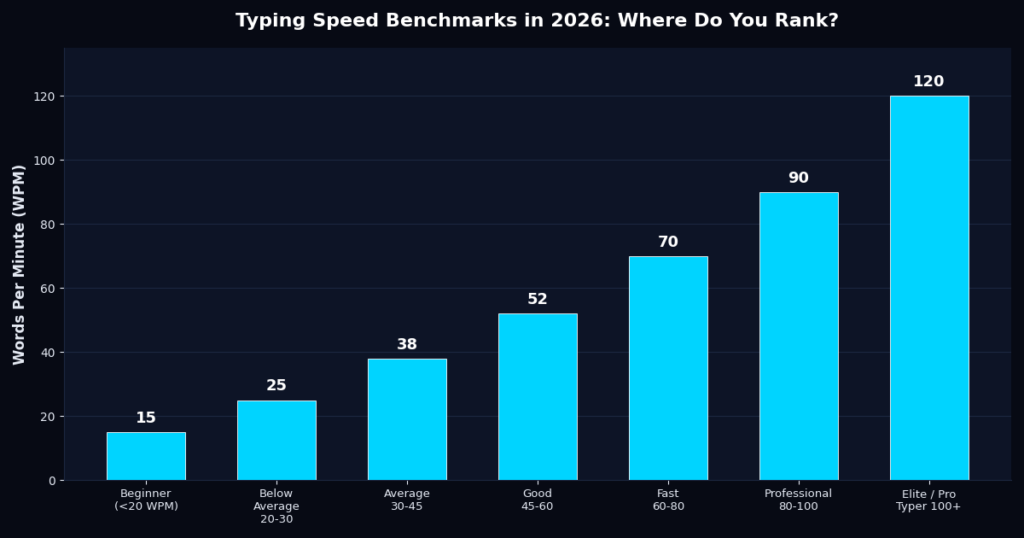
Typing Speed Tiers
| Tier | WPM Range | What It Means |
|---|---|---|
| Beginner | Under 20 WPM | Still learning key placement; hunt-and-peck typing |
| Below Average | 20–30 WPM | Basic proficiency, frequent look-downs at the keyboard |
| Average | 30–45 WPM | The general population average; comfortable for everyday use |
| Good | 45–60 WPM | Solid for most office jobs and daily communication |
| Fast | 60–80 WPM | Above 90th percentile; strong candidate for data-entry and admin roles |
| Professional | 80–100 WPM | Typical benchmark for transcriptionists, court reporters (entry-level), and power users |
| Elite / Competitive | 100+ WPM | Competitive typing territory; top typists on leaderboards regularly exceed 130–150 WPM |
For most adults, 40 WPM is considered average, and anything above 65–70 WPM puts you comfortably ahead of most of the population. If your goal is a data entry, transcription, or virtual assistant job, employers commonly ask for 50–70 WPM with 95%+ accuracy as a baseline requirement.
Does Typing Speed Still Matter in the Age of AI?
It’s a fair question. With tools like autocomplete, AI drafting assistants, and dictation software now built into most operating systems, some assume manual typing speed is becoming obsolete. But a few realities keep WPM relevant in 2026:
- Real-time communication still runs on typing. Slack, Discord, live customer support chats, and collaborative documents all reward speed and accuracy in the moment — AI can’t type your side of a live conversation for you.
- Coding and technical work rely on manual input. Developers, IT admins, and data analysts spend hours a day typing code, queries, and commands where AI-generated content still needs manual review, editing, and adjustment.
- Typing speed correlates with cognitive fluency. Fast, accurate typists tend to think and translate ideas into text faster, which compounds across a full workday.
- It’s a measurable, testable skill. Unlike “AI proficiency,” WPM is objective, quick to test, and still used in hiring assessments across administrative, legal, medical transcription, and customer service roles.
If you use our Spacebar Test or CPS Test to measure raw clicking/tapping speed, think of a WPM test as the same concept applied to a far more common daily task — typing.
Factors That Affect Your Typing Speed
- Keyboard layout familiarity — QWERTY is standard, but switching layouts (Dvorak, Colemak) temporarily tanks speed before eventually improving it for some typists.
- Touch typing vs. hunt-and-peck — touch typists who never look at the keyboard consistently outperform those who do, often by 2–3x.
- Muscle memory and repetition — speed is a trained skill, not a fixed trait; daily practice compounds quickly.
- Keyboard hardware — mechanical keyboards with responsive switches can shave meaningful time off travel distance versus low-quality membrane keyboards.
- Test duration — shorter tests (15 seconds) tend to produce higher peak WPM than longer tests (2–5 minutes), since fatigue and error correction have less time to accumulate.
- Content difficulty — random word lists are typically faster to type than punctuation-heavy or technical passages.
How to Improve Your WPM Score
- Learn proper finger placement. Anchor your fingers on the home row (ASDF / JKL;) and resist the urge to look down.
- Practice in short, frequent sessions. 10–15 minutes daily beats a single long weekly session for building durable muscle memory.
- Prioritize accuracy before speed. Speed built on sloppy habits caps out quickly; accuracy-first practice raises your ceiling.
- Use real typing tests, not just casual typing. Structured practice with instant feedback (like our WPM Test) trains you faster than ambient typing during work or chat.
- Track your progress over time. Testing weekly shows whether your training is actually translating into gains, and where plateaus form.
- Warm up before high-stakes typing tasks. Just like athletes stretch before performance, a 2-minute typing warm-up noticeably boosts short-term speed and accuracy.
Test Your Typing Speed Now
Curious where you actually land on the 2026 typing speed scale? Run our free, no-signup WPM Test and get instant Net WPM, accuracy, and error breakdowns. Pair it with our CPS Test to check your click speed, or try the Aim Trainer if you’re benchmarking overall reflex and precision, not just typing.
Frequently Asked Questions
What is a good WPM for a 12-year-old? Around 20–30 WPM is considered solid for a middle schooler still developing touch-typing habits; competitive young typists can reach 50+ WPM with consistent practice.
What is the world record for typing speed? Competitive stenography and typing records have exceeded 200 WPM in short bursts, though sustained real-world speeds for even elite typists usually settle in the 120–150 WPM range.
Is 40 WPM good or bad? 40 WPM sits right around the general population average — not slow, but not exceptional either. It’s a comfortable baseline for everyday computer use.
How can I type 100 WPM? Reaching 100 WPM typically requires consistent touch-typing practice over several months, strong accuracy habits, and familiarity with your specific keyboard — it’s achievable for most people with regular training, not just “naturally fast” typists.
Does WPM matter for programming jobs? Typing speed helps but matters far less than logic, debugging, and problem-solving skills for developers — though faster typing does reduce friction during long coding sessions.
Ready to see your number? Try the WPM Test on CPS Testers and compare your results against the 2026 benchmarks above.