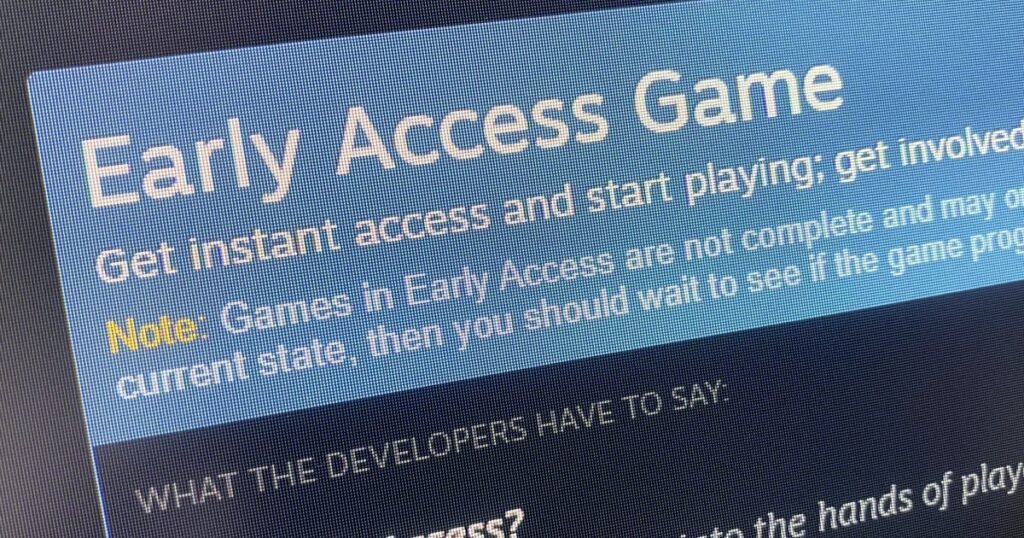
The variety of video games launched by Steam’s Early Entry program has risen considerably lately. In keeping with SteamDB, 2,924 Early Entry video games launched on Valve’s platform in 2026 (as of mid-October), an 18% improve from 2025 and a 60% improve from 2020.
As a share of the general variety of Steam video games launched every year, Early Entry titles are on the rise, going from a ten.4% share in 2024 to 11.3% in 2025 and 13.7% in 2026.
When Steam launched its Early Access program in 2013, it opened a priceless door for solo builders and smaller studios, permitting them to boost capital mid-development whereas concurrently constructing hype and gathering very important participant suggestions forward of a 1.0 launch. Do not Starve, Baldur’s Gate 3, and Lifeless Cells are just a few examples of how a constructive Early Entry interval can result in long-term success.
However somewhat than merely shopping for time to tinker, a sport’s Early Entry launch is now simply as necessary as its “actual” launch. GameDiscoverCo reported that solely 21% of Steam Early Entry graduates earned extra of their first 30 days after 1.0 than after their Early Entry launch.
GamesIndustry.biz spoke to the studios behind Valheim, Subnautica, Hades, Phasmophobia, Paralives, and Deadhaus Sonata in regards to the rising bar for Early Entry releases, the advantages and pitfalls of gathering participant suggestions, and the issues they might have performed in a different way.
The standard bar rises
These days, in the case of Early Entry, completely something goes, says Anthony Gallegos, inventive director of Subnautica 2. “It isn’t a couple of edge-case video games collaborating anymore,” he tells GamesIndustry.biz. “Early entry might imply a sport like ours doing long-term open improvement, or it may very well be a sport three months from a 1.0 launch that is successfully doing a paid beta gentle launch and utilizing the Early Entry time period as a method to soften participant expectations.”
All in all, that makes for a “extra numerous and complicated panorama,” he says.
One factor is for certain although: competitors within the Early Entry area is increased than ever. Daniel Knight, CEO and sport director at Phasmophobia maker Kinetic Video games, says that whether or not Early Entry or 1.0, new releases must be at “a a lot increased high quality.” Paralives developer Alex Massé says he ended up delaying the sport’s Early Entry launch from December 2025 to Could 2026 after pre-release checks revealed the tutorials and another options weren’t as much as scratch.
Richard Svensson, CEO of Valheim developer Iron Gate, believes that participant expectations for an Early Entry sport are about 20% decrease than for a full launch, however they’re nonetheless excessive. “They is likely to be extra forgiving in the case of content material, however they nonetheless anticipate a sophisticated sport.”
Nevertheless, for Denis Dyack, CEO of Deadhaus Sonata developer Apocalypse Studios, a key issue that is making the panorama tougher is that anybody, together with “large publishers with insane quantities of cash, manpower, and assets,” can launch a sport into Early Entry.
“They will put up a sophisticated product and rake in money; it is a advertising beat for them,” he explains. “So, that leaves gamers typically anticipating a near-perfect sport that, in our opinion, defeats the aim of Early Entry, which is a collaborative improvement course of based mostly on participant suggestions. AAA publishers are abusing Early Entry, skewing participant expectations in such a manner that it closely disadvantages smaller impartial builders.” He cites Subnautica 2 and Path of Exile as examples of Early Entry video games “drastically altering the panorama and gamers’ expectations.”
Dyack explains that Apocalypse Studios by no means anticipated Deadhaus Sonata to be in comparison with Early Entry video games with AAA budgets and, consequently, says the group hit “important obstacles to entry” and had their market affect “considerably decreased.”
“Smaller groups are being held to a a lot increased customary than they have been up to now”
“Gamers naturally evaluate the whole lot in the identical market, so smaller groups are being held to a a lot increased customary than they have been up to now,” provides Ethan McKinnon, inventive director at Apocalypse Studios.
Each McKinnon and Dyack advise builders coming into Early Entry to maintain this in thoughts, recommending in addition they prioritise robust sport efficiency (and an comprehensible idea), take Steam evaluations into consideration, and construct belief with influencers to go toe-to-toe with AAA advertising budgets. “Builders must deal with Early Entry like an actual launch, as a result of gamers do,” McKinnon says.
Key to success
Early Entry has been an unimaginable boon for quite a few builders. “If Early Entry as a mannequin hadn’t existed, Valheim by no means would have gotten as large because it did,” says Iron Gate CEO Richard Svensson. “Even when we had an infinite finances and labored on the sport in secret for 5 years up till the launch, we by no means would have been capable of attain the quantity of people who we’ve got.”
“Having the sport on the market and having the ability to work with the reside group is admittedly the one manner that Valheim would have ever reached the success it has.”

Subnautica is one other sport that benefited massively from the initiative. “When the primary Subnautica entered Early Entry, it was a brand new program for Steam, with no actual course of or understanding of what did and did not work,” recollects Gallegos (the sport launched in December 2014, the 12 months after this system began). “The group considered it as a possibility to experiment with content material and options alongside gamers in actual time.” The experiment paid off in each monetary and improvement phrases, with participant suggestions being instrumental in shaping the sport’s route.
So when it got here to deciding whether or not Subnautica 2 ought to launch in Early Entry, there was “no choice to make,” Gallegos says. “Collaborating in Early Entry means we will nonetheless pivot and alter the sport in significant ways in which merely launching an entire expertise and hoping we bought it proper would not enable,” Gallegos explains. “It is core to our DNA now.”

Greg Kasavin, inventive director at Supergiant Video games, can also be a convert. “Early Entry improvement was instrumental to the success of the unique Hades, inspiring us to make a much bigger and higher sport than we might have in any other case,” he says. “So we knew we wished to reapproach that course of with Hades 2.”
The chance to realize some a lot wanted funding is among the large attracts of Early Entry. After beginning the quirky life-sim Paralives as a solo challenge in 2019, Massé used funds raised by Patreon to place collectively a studio to develop it, however he nonetheless faces a Goliath. Paralives’ most important competitor, The Sims 4, boasts over 12 years of content material and the monetary backing of EA.
In keeping with Massé, for Paralives to supply the identical quantity of content material and options, a “ton of labor” is required. So he launched Paralives into Early Entry in Could 2026 – and inside eight hours, it had offered 250,000 copies. “As a small group and due to the scope of the sport, Early Entry was the one possibility,” Massé says. “[It] gave us monetary safety and allowed us to gather an enormous quantity of suggestions that we will use to enhance the sport.”
The sport changer
Direct suggestions out of your audience is one other key draw of Early Entry. “Talk overtly along with your gamers,” advises Gallegos. “Be trustworthy with them and make them perceive how essential they’re to the method. Protect your imaginative and prescient, however hearken to them and allow them to enable you to carry the most effective out of your sport.”

Svensson echoes this sentiment. “You must do not forget that it is about working with a group. Should you do not need to try this, you may as properly develop your sport by yourself and launch it as soon as it is performed,” he says. “Nevertheless, you must just be sure you nonetheless have a transparent imaginative and prescient for the sport you need to make; in any other case, you threat getting run over by the group fully.”
To butcher an outdated saying, no plan survives contact with the gamers. Nevertheless it’s nonetheless necessary to have one. “Go into it with a plan,” advises Knight. “But in addition be prepared to alter the plan.”

It might probably typically be a bit overwhelming. Massé explains that the wealth of suggestions the group has obtained in Paralives’ first few months has been extremely helpful, however cautions that it is “straightforward to get misplaced in it,” particularly as some gamers need extra give attention to new content material whereas others need function enhancements. “It might probably turn into troublesome to determine what to prioritise subsequent,” he says.
However Knight says that participant suggestions has been essentially the most priceless takeaway from Phasmophobia’s Early Entry interval. “It is allowed the sport to virtually rework into one thing else,” he explains. “By the point we get to 1.0, Phasmophobia goes to be a a lot larger and higher sport.”
Limitless Early Entry
In keeping with GameDiscoverCo, the common Steam Early Entry interval is 21 months – however some video games linger for for much longer than that. Massé is hoping Paralives will go away Early Entry in 2028, some two years after it launched; however Valheim stayed in Early Entry for over 5 years.
A part of the reason being that the boundaries stored altering. Svensson says he began Valheim as a solo challenge, however launched it into Early Entry in February 2021 as he “could not afford to maintain engaged on it,” and Early Entry appeared like “the one cheap resolution on the time.” Within the first month, it offered greater than 5 million copies; by 2022, over 10 million. Valheim 1.0 was lastly launched on September 9, 2026, by which period it had offered 17 million copies.

“The unique plan was maybe two or three years in Early Entry, however with each replace our ambitions have solely elevated,” Svensson explains. “We have now additionally at all times tried to maintain the group comparatively small, besides, the manufacturing scale now’s gigantic in comparison with what it was on the time of the Early Entry launch,” Svensson says.
The bar simply retains getting increased. “Again then, after we made a brand new biome, it was principally the identical factor with a brand new coat of paint, however at the moment it is simply a lot extra,” he explains. “It isn’t nearly content material anymore, and that is what made the event time longer than we first anticipated.”
Phasmophobia has had an analogous story, with sudden success forcing a change of tack. Like Valheim, it began as a solo challenge, and Knight labored on it for 5 years earlier than launching the net co-op horror sport into Early Entry in September 2020. By the top of the primary week, it had offered virtually 100,000 items – his goal had been 1,000 items within the first 12 months. The unique plan was to easily add extra content material and options for the 1.0 launch, however the scope simply grew and grew.

“Clearly, I did not put together for what was going to occur,” Knight says. “The 1.0 ended up fully altering from what I had initially deliberate it could be.”
“My preliminary plan was to do Early Entry for perhaps as much as two years, and simply so as to add new content material and never overhaul the whole lot,” he says. “However because of the success of the sport, I needed to fully change my plans.”
The complete launch was anticipated in 2026, however has now been delayed to the second half of 2027, with a poorly received participant character replace in Could 2026 being “one of many greatest causes” for the delay. “It did not meet the standard bar we set for ourselves,” Knight explains. “And the standard stage we need to get to for the 1.0 is rather a lot increased than the standard stage that we’ve got been releasing earlier than.”
A studying expertise
Early Entry does not at all times go easily. Svensson’s greatest remorse about Valheim’s Early Entry launch was the roadmap. “It was rushed out as a result of it was just about a requirement for Early Entry video games on the time,” he says. “Nevertheless it was not thought by correctly, and it was solely a few months earlier than we deserted it fully.”
He advises different builders making ready an Early Entry roadmap to “be certain it is even remotely doable, and maintain it obscure. We simply made one thing up that sounded good, and that got here again to chew us.”

Gallegos, in the meantime, says essentially the most priceless lesson Unknown Worlds realized from Early Entry was to experiment rapidly with new options. “Attempt to ship as quickly as attainable,” he advises.
“Subnautica typically launched options after they have been very ugly, incomplete, or prototype,” he explains. “This gave followers an actual sense of attending to see sport improvement in progress, in a manner few different studios would attempt, particularly for a franchise as large as this.”
He says that Unknown Worlds has “cultivated a really empathetic viewers by radical transparency,” with gamers prepared to simply accept work-in-progress options. “We belief the viewers to present us a bit grace as we determine issues out, they usually in flip belief us to make it nice within the fullness of time,” he says.
However typically the viewers just isn’t so accepting.

Denis Dyack has over 30 years of expertise within the video games business, and beforehand based Silicon Knights (creator of Legacy of Kain), Precursor Games, and Quantum Entanglement Entertainment. The outspoken (and controversial) video games veteran is now CEO of Apocalypse Studios, which launched the darkish fantasy ARPG Deadhaus Sonata into Early Entry in Could 2026 to bypass what Dyack describes because the “risk-averse, paint-by-numbers design” of contemporary AAA improvement.
“Launching into Early Entry was supposed to present the studio the runway to experiment with unconventional, systemic ideas that conventional publishers would reject,” he explains. “We imagine video games ought to deserve one thing really new and modern, and that Early Entry is among the greatest methods to roll one thing like this out to avid gamers.”
However Apocalypse rapidly obtained backlash from gamers over Deadhaus Sonata’s efficiency points, bugs, lack of content material, clunky gameplay, and unpolished state. “We did not prioritise the fundamentals proper from the get-go,” Dyack says. “Additionally, we did not deal with Unreal Engine correctly on the time and did not do a superb job explaining what made our sport cool and totally different. In plenty of methods, we have been too targeted on what made our sport so totally different and distinctive that it took our consideration away from ensuring we bought the fundamentals performed proper.”

The suggestions was sobering, forcing the group to do “plenty of soul looking” earlier than making main adjustments to the group and sport. McKinnon was introduced on board to fully overhaul the visuals and add new gameplay content material forward of the Darkish Rebirth replace arriving in October 2026.
However on the constructive facet, getting that early (albeit unfavorable) suggestions has given the group time to make these large adjustments earlier than a full launch – when it might have been way more detrimental and tougher to shake off. “The laborious half is that folks nonetheless type a primary impression in Early Entry, so it’s important to earn a few of these gamers again later,” McKinnon says. “That could be a large motive we’re exhibiting extra of the work now and letting individuals see the place the sport goes.”
For Apocalypse Studios, Deadhaus Sonata’s Early Entry launch was a “demoralising” however priceless lesson that is shaping their improvement going ahead. “Actually, we simply do not need to get punched within the face once more,” Dyack says. “That is been motivation sufficient to actually rebuild the sport from the bottom up.”