
The period of generative AI has kindled an period of generative AI witchhunts. It is routine proper now for videogame builders to fend off accusations of utilizing the know-how, even when they’re full-throated of their disapproval of ChatGPT, Claude and their ilk. Current examples include Sandustry, the 2D manufacturing unit builder from Hooded Horse with strangely haunting physics, and the just-announced Humankind 2, whose creators Amplitude have rushed to assure players that their announcement trailer is real reside motion movie.
The dialog displays a shifting thought of what AI-generated imagery ‘appears to be like like’ – shifting as a result of, strictly talking, AI-generated imagery has no mounted type or high quality. It is derived from no matter information the mannequin is ‘fed’. The confusion is exacerbated by the truth that the know-how is altering, with new or up to date buzzwordy instruments being added to the pile. Established hallmarks of generated imagery go outdated quick. In the meantime, generative AI’s advocates muddy the waters, conflating instruments and framing their capabilities in ludicrously open-ended, investor-baiting phrases. Nonetheless, some duty falls on common customers who’ve develop into accustomed to chucking round claims of “AI slop”.
Over the previous few weeks, I have been chatting to sport builders and artists who’ve been falsely accused of utilizing genAI for visible artwork specifically, whereas additionally making an attempt to grasp why, precisely, their photographs and movies attracted suspicion. It has been a humorous journey, each miserable and at occasions uplifting. The problem of figuring out generated imagery at a look is a political and social precedence that goes far past videogames – genAI fakes are routinely used to govern individuals and foment conspiracies, together with racist and xenophobic narratives about the “great replacement”. We have to develop into higher at recognizing the snakeoil salesmen in our midst. However extra positively, studying tips on how to spot genAI can be the act of bettering your visible and technical literacy. It is a technique of changing into extra intimate with artwork that captivates us.
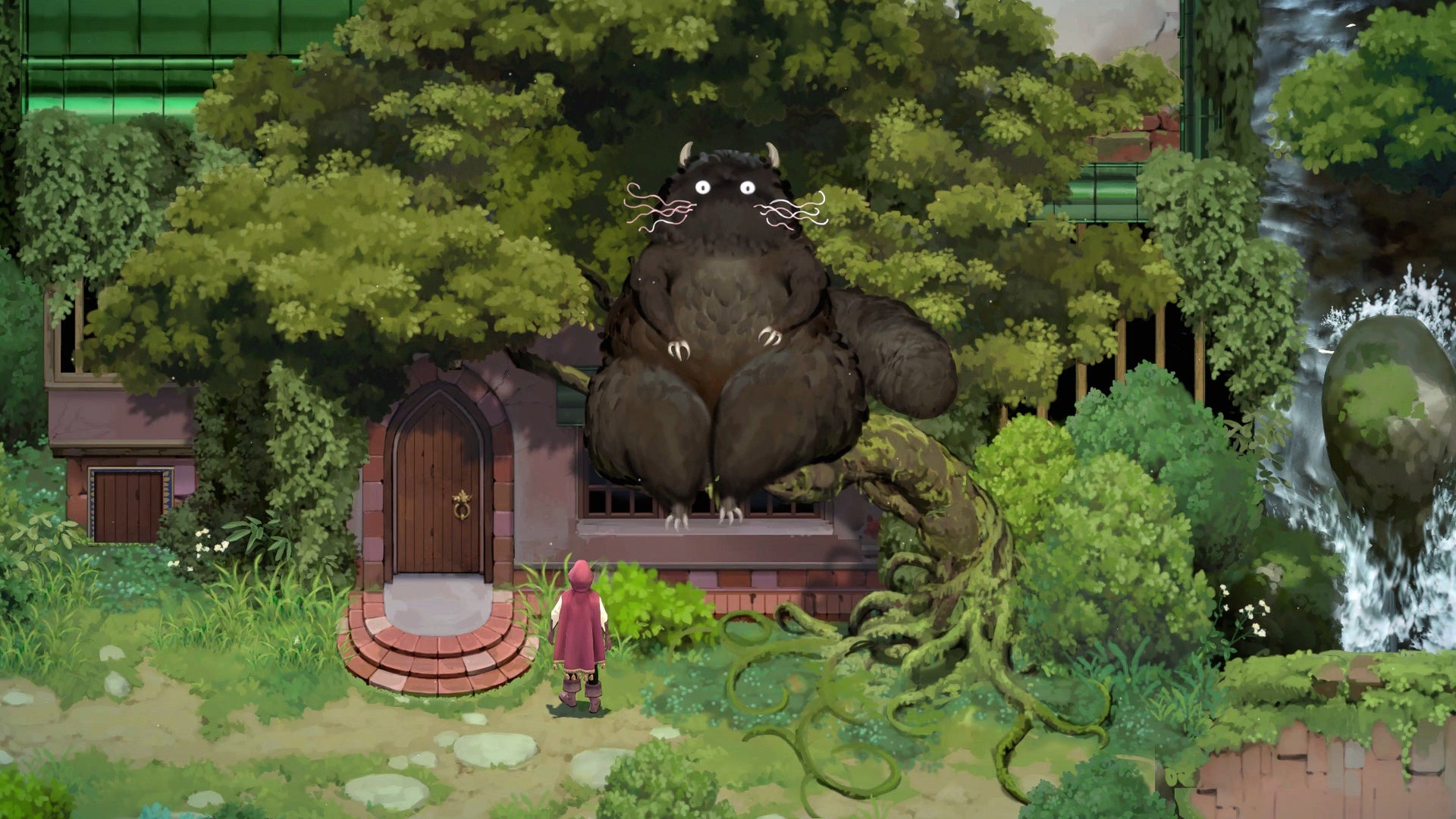
Hannah Flynn, comms director for Fallen London and Sunless Skies builders Failbetter, is used to getting flak on-line. “Most of my job is anxious with placing our video games in entrance of latest individuals,” she tells me over electronic mail. “Success in my efforts means consideration on us, which has at all times been a double-edged sword (I am grateful that it has been some time since somebody requested me for ft pics, although I worry it is by no means removed from occurring once more). It’s a brand new growth, although, that if a video will get shared extensively or we’ve a giant announcement, we’re assured to get requested whether or not or not we’re utilizing genAI.”
Failbetter have a statement on the website for his or her flagship literary text-me-do Fallen London, swearing off any and all generative AI utilization of their video games. “A few of [the] feedback signify real concern from our group, who’ve perhaps learn our AI assertion and are fearful that we have reneged on it, or violated it unintentionally,” Flynn goes on. “I do not thoughts reassuring our group personally; reservations in regards to the high quality of genAI’s outputs apart, we take quite a lot of pleasure in our craft and nobody right here is considering switching profession to AI wrangler.” Extra bothersome, she says, are the “social media fly-bys from individuals who don’t appear invested in our video games or the studio”.
New Blood Interactive CEO David Oshry has additionally been heading off generative AI accusations. With regard to the forthcoming Tenebris Somnia, a promising horror sport that mixes top-down pixelart with reside motion movie, New Blood finally created a behind-the-scenes video displaying off the creation of some props to close down claims that they’d been coughed up by a chatbot. I emailed Oshry to ask whether or not this was a pre-emptive gesture, or a response to some particular allegations. “LOOK AT THE COMMENTS AND YOU TELL ME,” he replied, sharing hyperlinks to some previous videos.
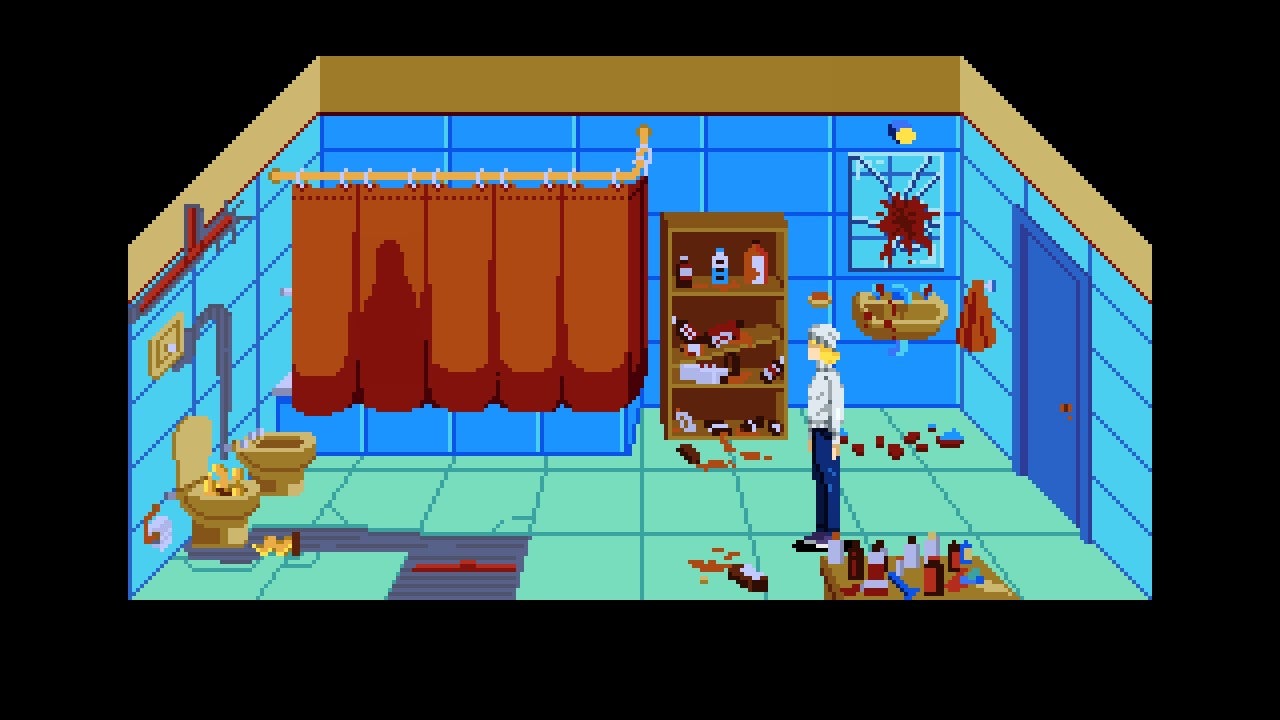
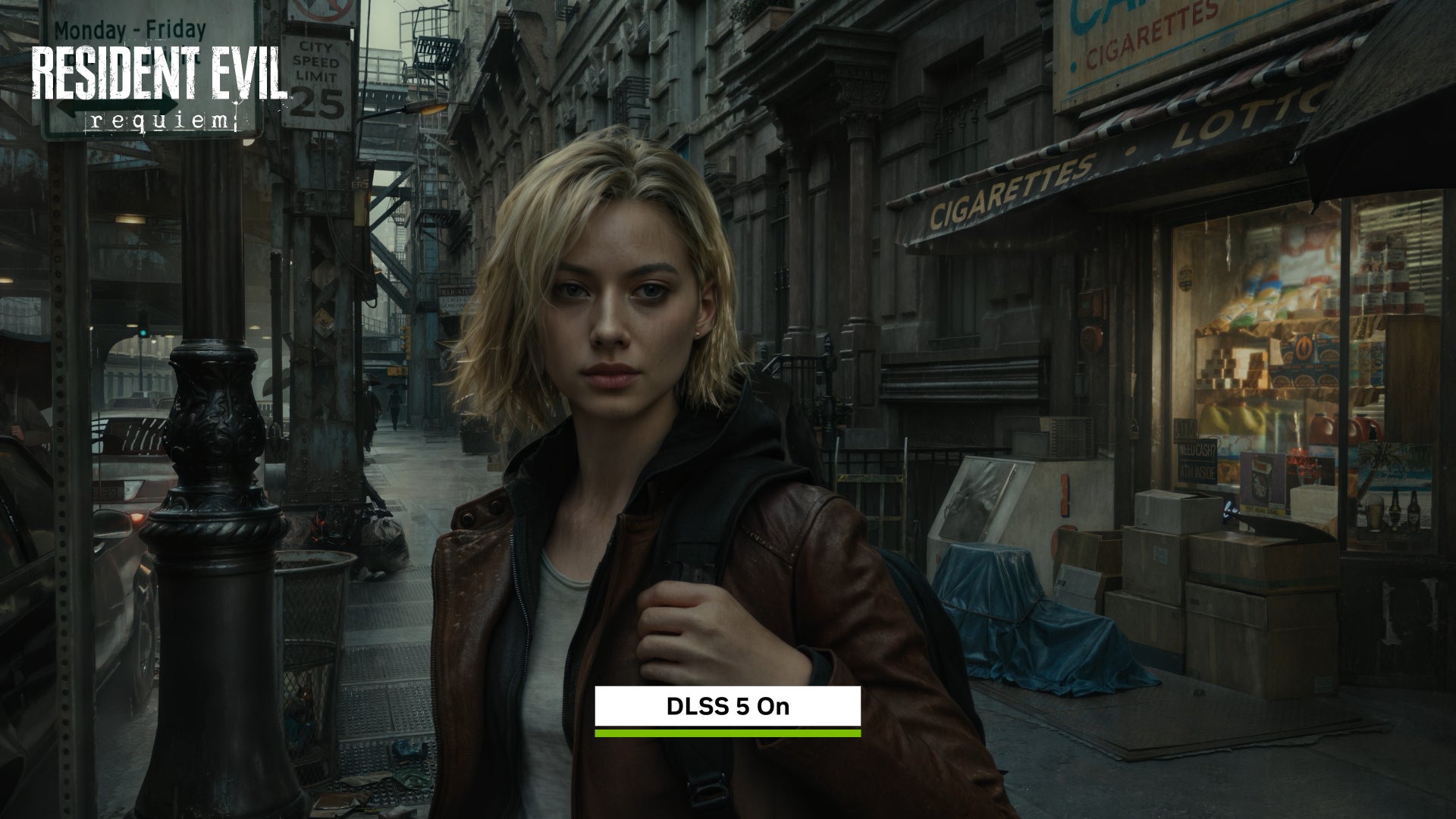
In line with Oshry, allegations about generative AI have develop into “just about non cease” when sharing footage of New Blood video games on social media, and particularly Instagram – galling, provided that he hasn’t been shy about his disdain for the likes of Nvidia’s face-plumping DLSS 5. “And we have seen it is solely very just lately this has occurred,” Oshry continued. “Even a yr in the past we noticed little or no of this and principally individuals simply saying ‘wow that appears so cool!'” Does he have any thought why Instagram customers specifically appear extra susceptible to this behaviour? “I feel brief type video platforms like Instagram and Tiktok have genuinely fried individuals’s brains.”
Nonetheless, Oshry is sanguine in regards to the suspicion, noting that the suggestions has really rebounded to New Blood’s profit. “All of the engagement has pushed up our wishlists (15k added within the final week), however it’s a bit exhausting,” he tells me. As with Failbetter’s tasks, a big proportion of the suggestions is from drive-by posters, and New Blood’s extra dedicated followers have come to their defence. “As you possibly can see within the feedback persons are fast to defend us and the sport and set the document straight,” Oshry goes on. “However we’d fairly be making cool content material ABOUT THE GAME fairly than making content material proving it is NOT AI SLOP. It’s what it’s.”

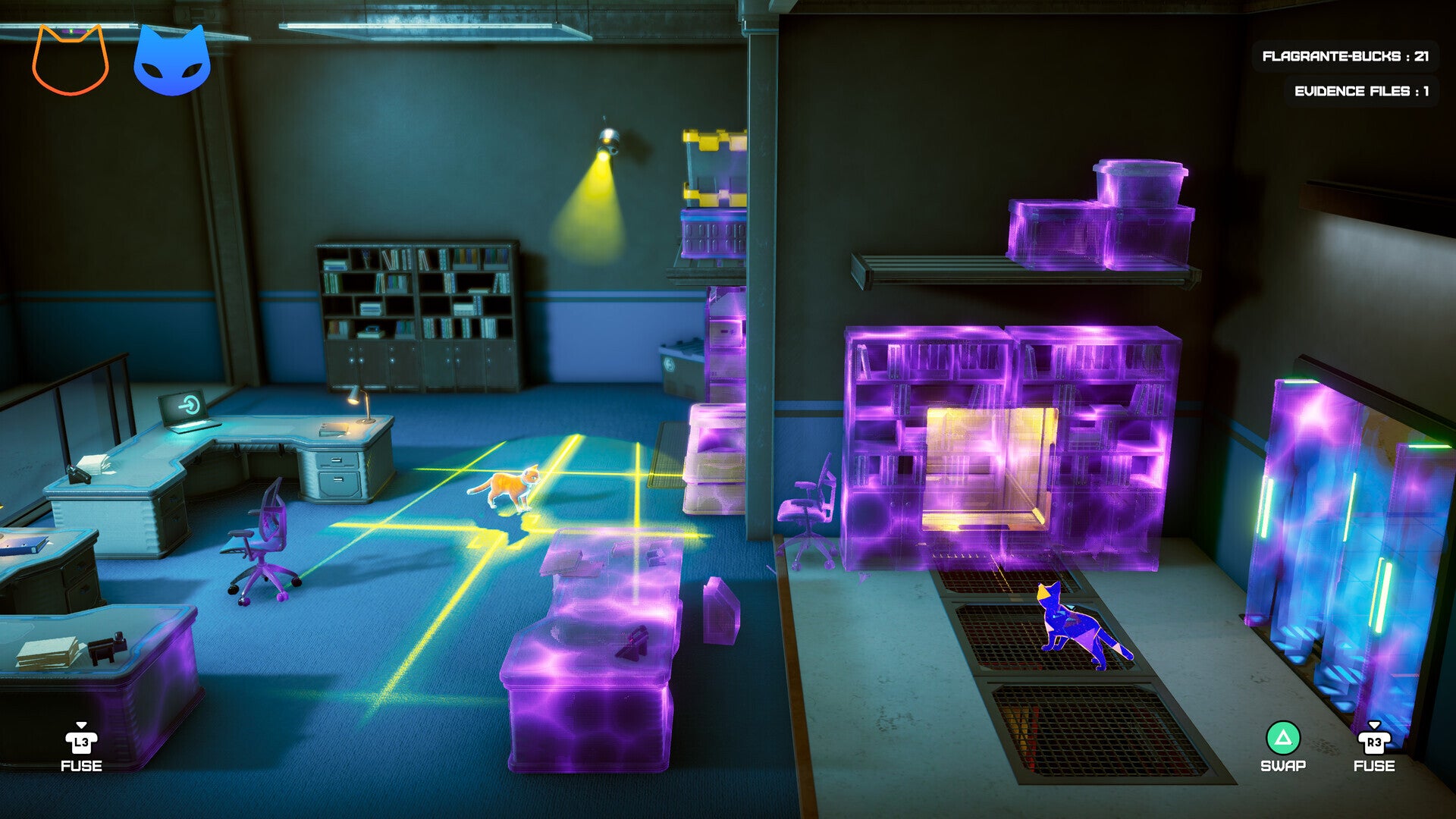
Even when accusations are unfounded, some studios could favor to alter their artwork fairly than cope with simmering distrust. Deserted Sheep, for instance, are the builders of Schrodinger’s Cat Burglar, a sport a couple of self-duplicating cat navigating a maze of Portal-style testing chambers. One of many sport’s older items of key artwork, proven on the proper, has been repeatedly known as out as AI-generated, as studio director and former Jagex and Sony Cambridge developer Martin Binfield tells me.
“This piece is hand painted by native artist Tom Williams (as is the present key artwork) and was produced in mid 2022 – predating GenAI’s skill to supply work to this normal,” he says. Nonetheless, Deserted Sheep in the end discovered it extra sensible to interchange the artwork than push again on the suspicion, not least as a result of after 4 years, the artwork was in want of a refresh. “Actually I do not begrudge these commenters for his or her vigilance,” Binfield feedback. “We as a studio have by no means and can by no means use generative AI, and I as a gamer additionally hate the concept that it would characteristic in a sport I wish to play. The ‘AI artwork? No sale’ commenters have their hearts in the proper place.”
All the above video games and artworks look very totally different, and it is tempting to throw your palms up and say there isn’t any rhyme or motive to a few of the accusations. “I truthfully do not know,” says David Oshry of Tenebris Somnia, with attribute forcefulness. “I feel individuals could have truthfully forgotten or are too younger to find out about sensible monster make-up and VFX and suppose every part is both Marvel-style CGI or AI now??? It is baffling. As a result of as somebody who sees a ton of AI slop on the web daily, Tenebris Somnia positively does not have “that” look. Or at the least we thought so!” Requested whether or not he has any ideas on the form of sport or aesthetic that will get misidentified as AI, he provides: “I’m very old-fashioned and never tuned in to this bullshit and take a look at to not be! I’ve seen individuals say that GTA 6 appears to be like like soulless AI slop at present so I feel we have all simply clearly misplaced the plot and hopefully a meteor will strike the earth quickly.”
Hannah Flynn is probably a smidge extra optimistic than Oshry. She muses that Failbetter’s “painterly artwork type” could learn as generated, as could its penchant for deliciously ‘aberrant’ our bodies that recall the disembodied limbs and knotted proportions of a barely older number of genAI photorealism. “It is usually noticed that AI photographs are skilled on classical types, which turns round on you whenever you’re utilizing a classical type to create by hand,” she says. “And in equity, we’re identified for eldritch horror – a few of our paintings genuinely does include too many eyes or fingers, however I promise it’s on goal!”
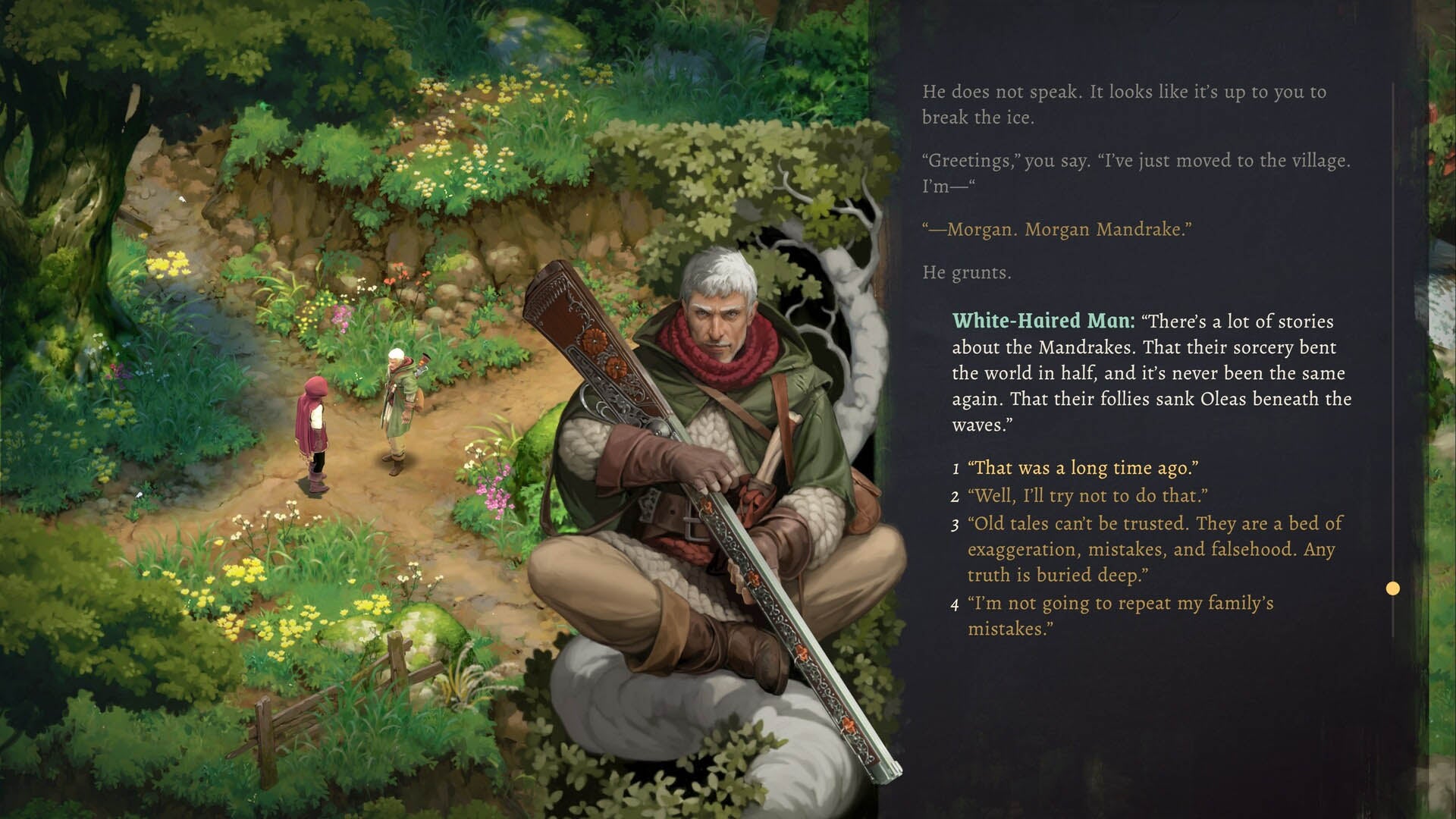
Flynn provides that the dialog about generative AI is, in some methods, inspiring. “The which means of made issues is a form of sub-theme” of Failbetter’s present undertaking Mandrake, a folkloric, Stardew-esque gardening sim invested with the studio’s ordinary mix of whimsical and macabre. “It feels on level to speak about,” she says, “and perhaps results in extra individuals spreading the phrase!” With out having performed Mandrake, I am unable to fairly get into the weeds of this, however it actually makes me curious to have a go.
If visible errors create grounds for suspicion, so too could immaculate execution. “From the feedback, it appears that evidently it was ‘unnaturally polished’,” says Martin Binfield of the important thing artwork for Schrodinger’s Cat Burglar. “I presume issues just like the airbrushing and the reflections within the cat’s eye had been the points that set individuals off, as there’s loads of tough brush-stroking within the piece at massive. This feels to me like a ‘cursed by success’ factor – Tom’s artwork was tremendous polished and prime quality, and one presumes that gen AI has ripped off the best high quality artwork work for its algorithmic slop bucket. To be accused of being AI in some circumstances is to be accused of being ‘too good to be true’.
“After all, different occasions AI accusations are due to an incorrect finger depend, however nonetheless,” Binfield provides. “One remark talked in regards to the cat having lacking enamel – undecided which enamel specifically they thought had been lacking, and the cat is hardly anatomically right anyway. I feel the primary pattern within the responses I seen was an absolute sense of being right. It was not often a query (‘is that this AI?’) and extra usually a declaration (‘no sale till you do away with the AI’). I put this all the way down to common internet-comment vanity – certainly, within the cases the place I replied and careworn that we weren’t utilizing AI they’d typically remark ‘that is nice to listen to! Sorry for getting it improper!’. Subsequent sport, I am going to attract the important thing artwork in crayon utilizing my left hand so it was clearly human-made…”
Whereas speaking to the builders about how their work has been misinterpreted, I have been occupied with my very own, patchy visible literacy and sensitivity to indications of AI era – I used to be embarrassingly caught out in a latest article on ASCII horror sport The Carcass. I have been searching for sources to hone my savviness. Among the many greatest I’ve discovered is this academic survey created by table-top sport and e book illustrator Janna Sophia Koppenwallner, which asks the person to kind the slop from a group of e book covers, archive pictures, snapshots from information broadcasts, and extra summary ‘positive artwork’. Within the course of, it feeds you suggestions: errors to be careful for, equivalent to pores and skin that has a sure Lovecraftian lustre, and contextual giveaways, equivalent to a shortage of biographical element in regards to the creator.
Koppenwallner is, in truth, writing a Masters thesis about human AI detection picture accuracy. “Earlier than I selected the subject I did a little bit little bit of analysis on human AI detection and located a number of research that claimed that it was no higher than probability,” she tells me over electronic mail (here’s one example). “I feel part of me did not wish to imagine that was true.”
I ought to stress that Koppenwallner’s information evaluation is ongoing and never but peer reviewed, with extra analysis wanted. Please scatter your salt shaker liberally over what follows. Nonetheless, her provisional findings are intriguing, and a bit discouraging. “The info I collected really reveals a mean detection accuracy of 74%, and located that individuals who completed a brief coaching module really did only a bit worse than those that didn’t,” she says, including that the precise distinction was “fairly marginal”, nonetheless statistically significant. “From what I’ve gathered to date, individuals did get overly suspicious and over-corrected, misidentifying actual images and artwork as AI generated,” Koppenwallner observes. This describes my expertise of her survey: I chalked up extra false positives than misses.

Koppenwallner herself has by no means been accused of utilizing generative AI, partly as a result of she’s been posting her art online for 15 years, so there’s ample proof that she’s cultivated her craft. She thinks artists who’re simply beginning out at present “may need a a lot more durable time”. I am curious to know whether or not beginner artwork with apparent blemishes is perhaps extra prone to being misidentified as AI-generated, and whether or not there are any creative traditions or types which can be by some means innately extra suspicious.
“There isn’t any information in my survey about that,” Koppenwallner started, “however anecdotally I’ve seen that these artists being falsely accused of utilizing gen AI had fairly widespread artwork types, that look very clear, extremely rendered and polished. Gen AI depends on immense datasets, and the extra information a mannequin has, the ‘higher’ the output. Most fashions nonetheless fail to re-produce area of interest artwork types, since there merely is not sufficient information for them to attract on. However that may change sooner or later, and once more, relies upon largely on the AI mannequin.” Koppenwallner provides elsewhere in our chat that each generative AI mannequin has “a definite visible language, which solely turns into obvious whenever you examine quite a lot of their output”. Nonetheless, she thinks that generated imagery traits extra usually come up from sure sorts of artwork being extra widespread.
As regards the chance of artists nonetheless mastering their strategies being branded genAI customers, Koppenwallner presents an enchanting dissection of ‘hand-crafted’ versus generated error. “On the subject of errors in artwork, the failure patters AI fashions produce are very totally different from errors a human artist would make,” she says. “AI tends to mix issues collectively (like hair out of the blue looping right into a necklace), as a result of the mannequin does not really know what it creates, it simply makes use of an excellent chance algorithm. Once more – this wasn’t a part of my thesis and is solely anecdotal – however human freshmen are likely to battle with proportions, color and lighting (which often the AI will get considerably proper), whereas most AI fashions battle with something that requires exact choice making, like lineart, particulars, textures and ornaments.”
In her questionnaire, Koppenwallner encourages individuals to observe their very own instinct – that nagging, inarticulate feeling that one thing about a picture is Fallacious. However she additionally echoes Martin Binfield in remarking that the sensation that one thing is ‘too good to be true’ can simply develop into sheer bias. Instinct must be intentionally modulated by examine. You must domesticate your personal style. “There’s really a really good book by Robin Hogarth about coaching instinct,” she says. “In line with him, instinct is skilled by suggestions, but when the suggestions is improper our instinct misfires. That is how prejudices are created within the first place. Sadly, coaching right instinct would require correct coaching and time to develop a sure degree of experience.”
Maybe inevitably, Koppenwallner has discovered that fellow artistic business employees do higher at her quiz than individuals in professions that do not contain making or sifting by visible artwork, however she thinks most web customers at the least have a sure passive experience with photographic media. “I nonetheless have to do a little analysis in that space, however I imagine that on common persons are higher at figuring out pictures fairly than artwork, since everybody, no matter occupation, is bombarded with images every day.”
We have hitherto mentioned how sure sorts of artwork may be misinterpreted as AI-generated. One other layer of fiendish complexity, worthy of an article in itself, arises once we begin speaking about sure marginally older machine studying instruments and methods of manufacturing photographs, which overlap a little bit with what’s now generally known as generative AI.
Abdou Bouam is a contract artist whose work encompasses “a little bit of every part actually” – from 3D videogame props and scenes to promoting product renders, academic movies, and different “sport adjoining” work. He recollects an occasion when a consumer questioned some photographs he’d despatched for suggestions, calling consideration to some blurry and vague patches, and asking if they’d been generated or edited utilizing AI. The blemishes had been, in truth, created by older denoising strategies.

I do know even much less in regards to the know-how of laptop graphics than I do in regards to the historical past of visible artwork. Fortunately, Bouam is keen to elucidate additional. To summarise his ideas, denoising is the automated elimination of random variations and anomalies from a picture. Amongst different issues, it is used to scrub up renders – that’s 2D photographs of 3D scenes – which can be created utilizing pathtracing. Pathtracing is a means of making bodily believable photographs of various objects and supplies by firing out rays from the digital camera and bouncing them round till they hit a light-weight supply, then calculating how a lot mild is transmitted again alongside the trail to the digital camera. Every repetition of this course of known as a pattern, and the completed picture is produced by averaging out the discrepancies between samples.
“The picture begins very noisy, then as extra samples are added and averaged, it converges to a closing consequence that is bodily correct,” Bouam tells me. “The one approach to get a noise-free picture is to render it for an infinite period of time, which is clearly not possible, so the higher strategy is to render it till the noise turns into so low that it may be denoised with little to no high quality loss.” The query, then, is how a lot time you possibly can afford to spend bouncing rays round earlier than reaching for the denoiser. The problem is that, as Bouam goes on, denoising blemishes can resemble signs of AI era. “Particulars get misplaced, blurred, and smeared with quite a lot of artifacting that simply seems like genAI.”
The opposite issue is that some denoising instruments like Nvidia Optix – first released in 2018, and utilized by many videogames that characteristic raytracing or DLSS – do fall below the umbrella of “machine studying”. However they pre-date “generative AI” as we now perceive it, and Bouam argues that they do not have the “similar moral issues”. Moderately than counting on entry to non-consensually obtained public information, for instance, the fashions in query are created utilizing archives of tailormade photographs, which “are purposely rendered with quite a lot of noise, after which in comparison with the noise-free ones that took ages to render,” as Bouam explains. “It is not skilled on stolen and unlicensed work. Even when you wished to, you possibly can’t simply take any image off the web and practice with it, you must use an precise manufacturing 3D scene with all the additional information it creates.”
These elder denoisers run regionally fairly than on datacentres, Bouam continues, and save power as a result of they drastically shorten the time required to create a suitable render. He additionally feels that they do not signify a lack of creative management. “It does not change the way in which my scene appears to be like, aside from smears and splotches if the pattern depend is simply too low and the scene is difficult to render. Nevertheless it does not change my lighting, or ‘yassify’ my characters, or anything like that.” In a nutshell: it is nonetheless his artwork.
I hope all these insights and reflections supply some form of steer, whereas navigating the rapids of a world wherein generative AI is being shoved into each vocation and past-time. I am aware, nonetheless, that any takeaways from this piece could quickly be out of date.
Once more, the tech retains altering. At the moment’s generated AI instruments show fewer of the unearthly mutations that characterised the primary iterations of Midjourney and ChatGPT. “Pure visible detection is getting more durable and more durable,” Koppenwallner tells me in closing, “and I feel most clues are within the context of a picture as of late (what am I seeing, why am I seeing this, can it’s true that I’ll get a completely rendered portray in two days for $200, and so forth). It is one factor to remember and to guard oneself, however I would be very, very cautious about calling somebody out for utilizing AI, primarily based on a hunch.”