
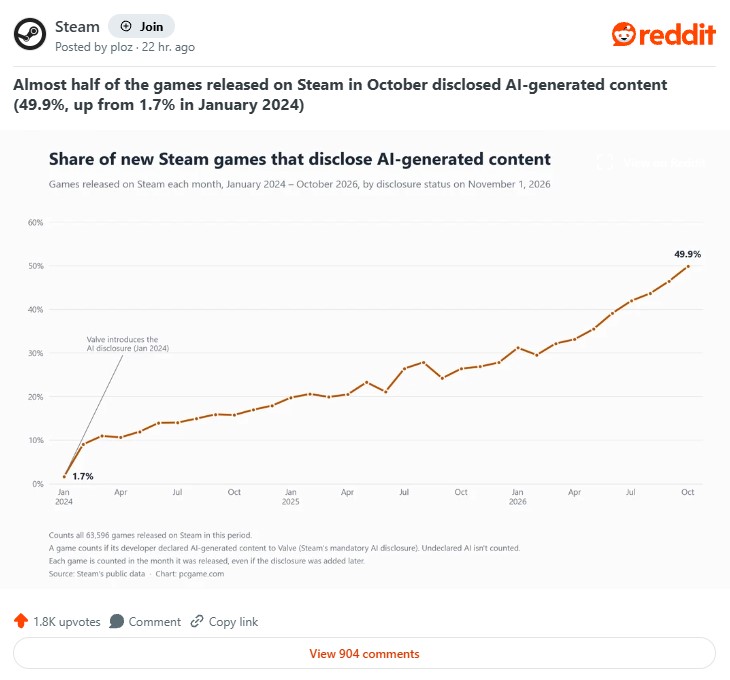
In October 2026, 49.9% of new Steam releases included a generative-AI disclosure. That determine comes from an unbiased evaluation of roughly 63,600 Steam releases by Reddit user u/ploz, who tracked publicly accessible store-page information, as reported by Dexerto.
That quantity shouldn’t be proof that half of Steam’s new games had been created by AI. A single disclosure can cowl one picture, one translated textual content string, or a store-page advertising asset.
The Development Curve Is Actual, No matter How You Interpret It
From a footnote to a near-majority in 34 months, the trajectory of AI disclosures on Steam is steep.
The disclosure fee stood at 13.2% throughout all of 2024. It climbed to 24% throughout all of 2025, then reached 40.1% for 2026 via October. October 2026 alone got here in at 49.9%, up from 26.4% recorded in October 2025.
Regardless of the scope of particular person disclosures, the normalization of generative AI in Steam releases is now not a fringe story.
The place Builders Say They Are Utilizing It
Art work leads each different class by a large margin; stay in-game era barely registers.
Amongst video games that disclosed AI use within the analyzed dataset, the breakdown by class is as follows, per the u/ploz evaluation as reported by Dexerto. As a result of one recreation can report a number of classes, these figures overlap:
- Art work: 63% of disclosures
- Textual content and translations: 30%
- Retailer-page and advertising materials: 26%
- Music: 21%
- Coding: 16% (Valve’s present coverage facilities on player-facing content material, so this determine warrants warning)
- Voices: 7%
- Reside, in-game era: 3%
Smaller and Excessive-Output Builders Are Driving the Numbers
The pattern is concentrated amongst lower-profile and prolific releases, not evenly distributed throughout the trade.
Video games with fewer than 10 critiques disclosed AI use in 47% of instances; video games with no less than 1,000 critiques disclosed it in solely 14%. Builders releasing 10 or extra video games per 12 months disclosed AI use in 68% of their titles, in contrast with 37% for builders releasing just one recreation per 12 months.
These correlations are in step with AI serving as a production-efficiency software for high-output and lower-profile releases. The information doesn’t set up why these teams disclose AI use extra typically.
What Valve Really Requires
The system covers what gamers see and listen to, not each software a developer makes use of internally.
Valve introduced the disclosure framework in January 2024. It covers player-facing content: visible property, audio, writing, localization, and a few advertising supplies. AI used purely as an internal development tool generally falls exterior the present disclosure requirement, as described in Steam’s framework and reported by Neoteo.
Steam doesn’t supply a local retailer filter to cover AI-disclosed video games. Third-party instruments reminiscent of SteamDB supply partial filtering based mostly on accessible disclosure information, however they can not establish video games the place AI use went unreported.
The Information Has Actual Limits
The figures measure what builders selected to reveal, and the absence of a disclosure shouldn’t be affirmation {that a} recreation used no AI.
The evaluation tracks reported disclosures, not independently verified AI use. Undisclosed AI use doesn’t seem within the dataset, whether or not as a result of no qualifying use occurred or as a result of a developer didn’t report it. The figures come from an unbiased researcher, not a peer-reviewed examine or Valve’s personal statistical report.
The presence of a disclosure doesn’t point out how extensively AI was used. What the information does verify is that AI-content disclosure has moved from an edge-case follow to a near-majority norm amongst new Steam releases in beneath three years.